Connect with us

Slider

Human-wildlife conflict in Zimbabwe is a crisis: who is in danger, where and why?

Published

on

BY BLESSING KAVHU

In the fishing villages along Lake Kariba in northern Zimbabwe, near the border with Zambia, everyday routines that should be ordinary – like collecting water, walking to the fields or casting a fishing net – now carry a quiet, ever-present fear. A new national analysis shows that human-wildlife conflict in rural Zimbabwe has intensified to the point where it has become a public safety crisis, rather than simply an environmental challenge.

Advertisement

Between 2016 and 2022, 322 people died in wildlife encounters. Annual fatalities climbed from 17 to 67: a fourfold increase in just seven years. These fatal encounters are concentrated in communities that live closest to protected areas and water bodies. Here, people and wildlife compete for space and survival.

Protected areas and rivers provide water, forage and shelter for wildlife. Rural households rely on the same landscapes for farming, fishing and domestic water. The study shows that this overlap between human activity and wildlife movement sharply increases the risk of fatal encounters.

Historically, human-wildlife conflict research and policy in southern Africa focused on economic losses such as destroyed crops, livestock predationand damaged infrastructure. Fatal attacks on people were often treated as rare or incidental. This study shifts that perspective by showing that human deaths are not isolated events, but a growing and measurable pattern that demands urgent attention.

Advertisement

I am a US-based Zimbabwean scientist working with Zimbabwean conservationists. We analysed national wildlife-related fatality records from the Zimbabwe Parks and Wildlife Management Authority. The central questions were: how many people are dying from wildlife encounters, where are these deaths occurring and which species are responsible?

The findings were stark. Fatal encounters are rising rapidly, are geographically clustered in the north and western districts, and are driven primarily by two species: crocodiles and elephants (not lions, as people might expect). The implications extend beyond conservation to include trauma, fear, retaliatory killings of wildlife and the need for targeted, locally specific interventions.

Patterns in the data

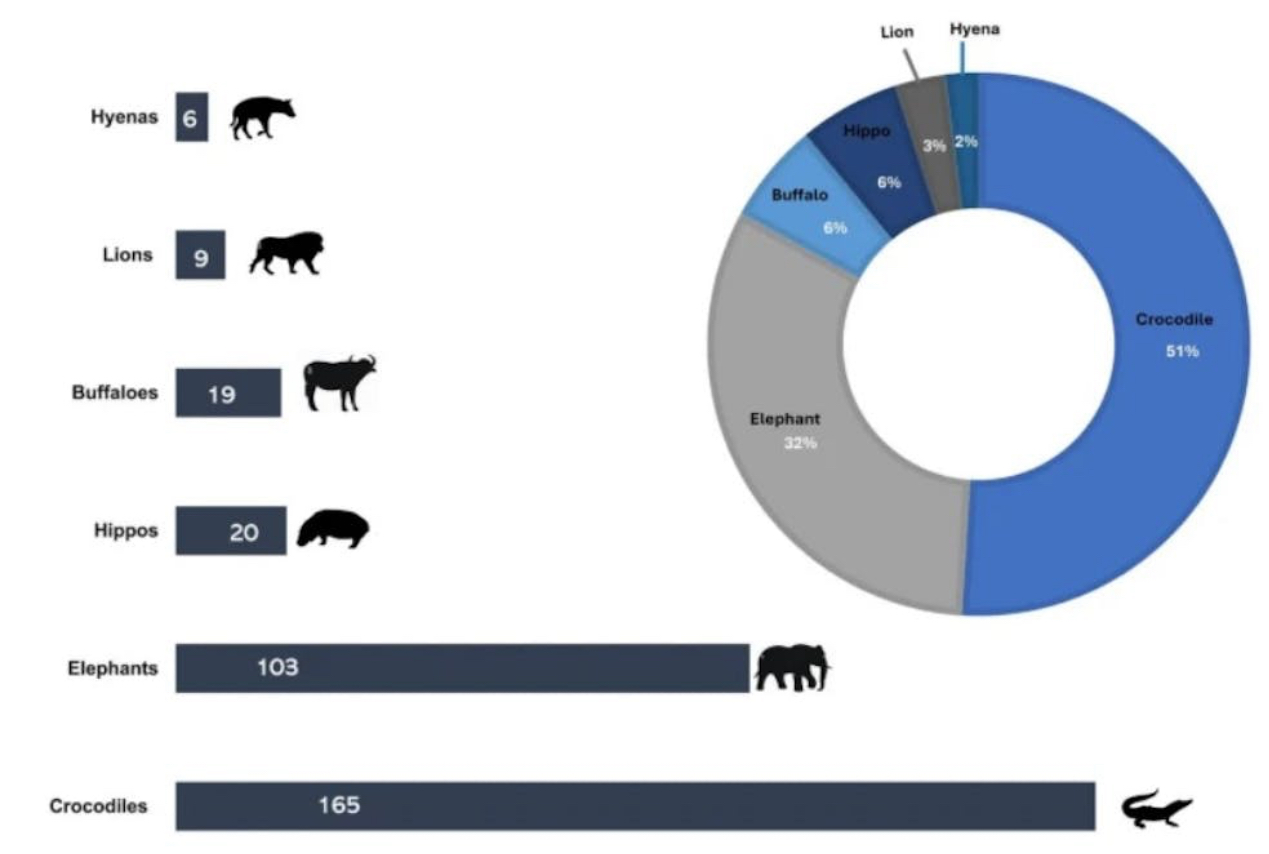
The study reveals that more than 80% of recorded deaths involved only two species, elephants and crocodiles. Crocodiles alone were responsible for slightly more than half of all fatalities. Many of these incidents happened during activities people cannot avoid: fishing, crossing rivers, bathing, or washing clothes in rivers and lakes. These encounters are sudden and often impossible to anticipate, especially in places where visibility is poor and safe water access is limited.
Advertisement

Elephants were responsible for nearly a third of the deaths. These happened mainly during crop-raiding incidents or when communities attempted to chase elephants from fields and homesteads, or when people were walking to school and work. These confrontations often occur at night or in the early morning when visibility is low. Lions, hyenas, hippos and buffalo contributed only 17% of fatal incidents during the study period.

The rise in lethal encounters appears to be driven by several overlapping forces. Zimbabwe still holds one of Africa’s largest elephant populations, estimated at over 80,000 animals. This is second only to Botswana. In dry years elephants move over long distances in search of water and forage, increasing their presence in communal lands. Shrinking natural habitats and growing rural populations mean that human populations are expanding into wildlife corridors. Climate change, particularly recurring droughts, intensifies the competition for water and space.

The geography of the fatalities reveals a clear pattern. Most deaths occurred in Kariba, Binga and Hwange. These are districts along the country’s northern and western frontier, with a combined population of about 343,264 people. They have large water bodies that support abundant crocodile populations; they are close to protected areas with high elephant numbers; and people there depend heavily on farming, fishing and natural resource use.

Advertisement

How people feel

These encounters leave people with fear. Parents become anxious about children walking to school, farmers worry about tending crops at dawn and communities may avoid crossing rivers.

But people aren’t getting mental health support. So grief and fear can turn into anger, often resulting in killings of wildlife. A destructive cycle undermines conservation and damages trust between communities and authorities.

What to do about it

Different places face different dangers, and solutions should reflect that.

Advertisement

Areas near crocodile-prone rivers need safe water access and crossing points and redesigned community washing areas. Districts where elephants are responsible for most fatalities require better early-warning systems, community-based monitoring networks and low-cost methods to deter elephants from crop fields. These measures must be paired with community education and consistent follow-up support.

The findings highlight that coexistence will not be possible without recognising the emotional and psychological dimensions of living alongside wildlife. The responsibility lies with government agencies working with communities. These must be supported by conservation organisations and health services. Counselling, community healing processes and long-term engagement can help break the retaliatory cycle.

Research from other African settings shows that targeted solutions grounded in community involvement and local risk patterns are key to reducing conflicts. In northern Kenya, community-based early warning systems that alert villagers to elephant movements have significantly reduced fatal encounters. Beehive fences and chili-based barriers have helped protect crops without harming wildlife.

Advertisement

In Uganda’s Murchison Falls area, surveys found that local people preferred physical exclusion measures and the relocation of specific crocodiles as ways to lower the risk of attacks. In South Sudan’s Sudd wetlands, communities identified crocodile sanctuaries as one way to reduce dangerous interactions. In Zambia’s lower Zambezi valley, villagers highlighted the need for more alternative water access points (such as boreholes).

These examples show that fatal encounters are not inevitable. When interventions are matched to the species involved and the daily realities of local communities, both human deaths and retaliatory killings of wildlife can be reduced.

Zimbabwe’s wildlife remains a source of national pride and a cornerstone of tourism. But conservation cannot succeed if the people who live closest to wildlife feel unprotected or unheard. A future where people and wildlife thrive together depends on acknowledging that human wellbeing is inseparable from the wellbeing of the ecosystems they share.

Advertisement

SOURCE: THE CONSERVATION 

Advertisement
Continue Reading
Click to comment

Leave a Reply

Your email address will not be published. Required fields are marked *

Slider

Conservation’s unfinished business

Published

on

BY RHETT AYERS BUTLER

SUMMARY:

Advertisement
  • A recent Nature paper argues that many persistent failures in conservation cannot be understood without examining how race, power, and historical exclusion continue to shape the field’s institutions and practices.
  • The authors contend that conservation’s colonial origins still influence who holds decision-making authority, whose knowledge is valued, and who bears the social costs of environmental protection today.
  • As governments pursue ambitious global targets to expand protected areas, the paper warns that conservation efforts risk repeating past injustices if Indigenous and local land rights are not recognized and upheld.
  • To address these challenges, the authors propose a framework centered on rights, agency, accountability, and education, emphasizing that more equitable conservation is also more durable.

Conservation often presents itself as a technical enterprise: how much land to protect, which species to prioritize, what policies deliver results. A recent paper in Nature argues that this framing misses something fundamental. Many of the field’s most persistent failures, the authors contend, cannot be understood without confronting how race, power, and historical exclusion continue to shape conservation practice today.

The paper, A Framework for Addressing Racial and Related Inequities in Conservation, does not claim that conservation is uniquely flawed, nor that injustice is universal across all projects. Its argument is narrower and more pointed. Modern conservation, it says, emerged from a colonial context that treated land as empty and people as obstacles. Those assumptions were never fully dismantled. They survive in subtler forms, influencing whose knowledge counts, who bears the costs of protection, and who decides what success looks like.

The authors, led by Moreangels Mbizah of Wildlife Conservation Action in Zimbabwe, trace conservation’s institutional roots to the late nineteenth century, when protected areas were established across colonized landscapes through forced removals and restrictions on customary land use. Indigenous peoples and rural communities were often excluded in the name of preserving “pristine” nature. Although conservation has evolved since then, the paper argues that these early patterns still shape present-day practice through what it calls “path dependencies”: inherited norms that continue to privilege outside expertise and centralized control.

One consequence, according to the authors, is the persistent marginalization of Indigenous peoples and local communities, particularly in the Global South. These groups are frequently described as “stakeholders” or “beneficiaries” rather than rights-holders with authority over their lands. The language may sound neutral, the paper suggests, but it often masks unequal power relationships. Even well-intentioned projects can reproduce older hierarchies if communities are consulted only after priorities are set, or if participation is limited to implementation rather than decision-making.

Advertisement

The paper pays particular attention to the current push to expand protected areas to cover 30% of the planet by 2030. In principle, the authors argue, this target could support more pluralistic forms of conservation, including Indigenous-managed territories and community conservancies. In practice, they warn, countries lacking legal mechanisms to recognize customary land rights may default to state-led models that repeat earlier injustices. Conservation success, measured narrowly through ecological indicators, can come at high social cost when human rights are treated as secondary concerns.

Another theme the authors examine is the way conservation narratives value animals and people. Campaigns aimed at audiences in Europe and North America often focus on the moral worth of individual animals, sometimes in ways that implicitly devalue the lives of people who live alongside wildlife. When human–wildlife conflict results in injury or death, local suffering may receive little attention, while the killing of a charismatic animal can provoke global outrage. The authors argue that such asymmetries are not incidental; they reflect deeper processes of “othering” that shape whose lives are seen as grievable or deserving of protection.

The paper is careful not to frame these dynamics as purely racial in a narrow sense. Instead, it emphasizes intersections of race, class, geography, and political power. Urban elites in low-income countries, the authors note, may exercise authority over rural communities in ways that mirror global North–South inequalities. Conservation led by local actors is not automatically just. What matters is how power is distributed and whether affected communities retain meaningful agency.

To address these patterns, the authors propose what they call the RACE framework: Rights, Agency, Challenge, and Education. The framework is not presented as a checklist or a universal solution. Rather, it is intended as a lens through which conservation organizations, researchers, and funders might examine their own practices.

Advertisement
The RACE model for conservation

Rights, in this framing, are foundational. The paper argues that conservation cannot be sustainable if it undermines basic human rights, including rights to land, culture, and self-determination. Agency follows from this: communities must have real authority over decisions that affect their territories, not merely advisory roles. Challenge refers to the obligation, particularly among powerful institutions and individuals, to speak out when conservation practices cause harm or exclusion. Education, finally, involves confronting conservation’s own history and recognizing knowledge systems that exist outside Western scientific traditions.

The authors stress that this is not about revisiting past wrongs for their own sake. Understanding history, they argue, is necessary to avoid repeating it under new banners. Nor is the framework framed as an attack on conservation itself. On the contrary, the paper insists that conservation outcomes are likely to be stronger when communities closest to the land are recognized as stewards rather than obstacles.

There is a pragmatic strand running through the analysis. Conservation, the authors note, increasingly operates in a politically fragmented world, with declining public funding and growing skepticism toward international institutions. Projects that lack local legitimacy are more vulnerable to conflict and reversal. Addressing inequities, in this sense, is not only an ethical concern but also a strategic one.

Advertisement

The paper does not pretend that change will be easy. Power, once accumulated, is rarely surrendered voluntarily. Nor does it suggest that conservation can resolve broader social injustices on its own. Its claim is more modest, and perhaps more demanding: that conservation must stop treating inequality as an external issue and recognize how deeply it is woven into the field’s own structures.

For a discipline accustomed to measuring success in hectares and population counts, this is an uncomfortable proposition. But the authors’ central point is straightforward. Conservation is about relationships—between people and nature, and among people themselves. Ignoring those relationships does not make them disappear. It only ensures that their consequences are felt later, often by those with the least power to absorb them.

SOURCE: MONGABAY

Advertisement


Advertisement
Continue Reading

National

Government warns farmers to step up tick control as January Disease threat looms

Published

on

BY STAFF REPORTER

The Ministry of Lands, Agriculture, Fisheries, Water and Rural Development has urged livestock farmers across Zimbabwe to heighten disease surveillance and tick control measures as the 2026 rainy season continues, warning of an increased risk of January Disease (Theileriosis).

Advertisement

In a farmer advisory posted on the Ministry’s official Facebook page, authorities said the tick-borne disease spreads rapidly under warm and wet conditions and can decimate entire cattle herds if not effectively controlled.

The Ministry emphasised that weekly cattle dipping is mandatory during the rainy season, in line with Government policy to curb the spread of the brown ear tick, the primary carrier of January Disease. Farmers were urged to pay dipping levies, ensure correct acaricide dilution as per manufacturers’ instructions, and utilise spray races where possible for improved effectiveness.

In high-risk areas or during active outbreaks, farmers may be directed to follow a 5:5:4 dipping regime, involving more frequent dipping intervals. The Ministry also recommended the use of tick grease on sensitive areas such as inside the ears, the udder and under the tail.

Advertisement

As part of broader prevention efforts, the Ministry said the locally produced BOLVAC vaccine is now available in increased quantities, with farmers encouraged to contact their local veterinary offices to access the vaccine.

Farmers were further advised to conduct daily inspections of their cattle and remain alert to early warning signs of January Disease, which include swollen lymph nodes, loss of appetite, breathing difficulties, frothing, watery or cloudy eyes, fever and general weakness.

The Ministry reminded farmers that all suspected cases or sudden cattle deaths must be reported to the Directorate of Veterinary Services within 24 hours, stressing that the movement of sick or tick-infested animals is prohibited as it contributes to the spread of the disease.

Advertisement

Failure to comply with dipping regulations constitutes an offence under the Animal Health Act, with penalties that may include fines or arrest, the Ministry warned.

Farmers requiring assistance or wishing to report suspected cases were advised to contact their local Veterinary Extension Officer or the Ministry of Lands, Agriculture, Fisheries, Water and Rural Development.

“Prevention saves wealth,” the Ministry said, urging farmers to take proactive measures to protect their herds.

Advertisement

Continue Reading

Slider

Wire snares continue to kill wildlife around Hwange, despite crackdown

Published

on

BY NOKUTHABA DLAMINI

Wire snares continue to take a heavy toll on wildlife in the forests surrounding Hwange National Park and the Victoria Falls wildlife corridors, despite intensified anti-poaching efforts.

Advertisement

Figures from the Zimbabwe Parks and Wildlife Management Authority (ZimParks) show that 1 760 wire snares were recovered in Hwange National Park and the Victoria Falls area in 2024.

In the first ten months of 2025, a further 1 048 snares were removed, underscoring the persistence of illegal snaring in one of southern Africa’s most important conservation landscapes.

ZimParks says snaring is most common along park boundaries and buffer zones, particularly around Sinamatella, Hwange Main Camp, Matetsi and Robins Camp, as well as in nearby communities such as Dete and Mambanje.

Advertisement

“Our teams remain actively deployed on the ground, conducting regular patrols and monitoring exercises to combat snaring and other illegal activities,” ZimParks said in a written response. “This consistent field presence has been instrumental in safeguarding wildlife populations.”

However, conservation organisations operating in these areas say the rising number of recovered snares points to an escalating problem rather than success.

Painted Dog Conservation (PDC), which runs extensive anti-poaching patrols in and around Hwange, describes wire snares as one of the most indiscriminate threats to wildlife.

Advertisement

“Poachers are quite skilled and know what they are targeting,” said David Kuvaoga, operations director at PDC. “But the snare itself is not selective.”

He said animals of all sizes are caught.

“We have seen elephants trapped by the trunk, lions, buffalo, giraffe and painted dogs,” Kuvaoga said. “Once an animal is caught, it can suffer for hours or days. Many die without ever being seen.”

Advertisement

PDC rangers removed more than 3 500 wire snares in 2024 across Hwange, the Gwayi Valley and surrounding forestry areas.

“For every snare we remove, there are animals that have already been injured or killed,” he added.

In the Victoria Falls area, the Victoria Falls Anti-Poaching Unit (VFAPU) has reported a steady increase in snaring incidents, particularly during the dry season when wildlife movements intensify.

Advertisement

VFAPU recorded 59 snares recovered in September 2025 and 54 in October, alongside confirmed wildlife losses including buffalo and hyena.

“Animals lost to poaching is always a bitter pill to swallow,” VFAPU said in its October operational report. “Sadly, we lost three animals that we know of. From every case, we learn more about how these poaching groups operate.”

VFAPU said the regular recovery of snares reflects active and ongoing poaching, prompting expanded patrols in collaboration with ZimParks and neighbouring ranger units.

Advertisement

At the Conservation Wildlife Fund (CWF) in Hwange, conservationists caution against viewing high snare recovery figures as progress.

“It is difficult to describe collecting snares as success,” said Debra Ogilvie-Roodt of CWF. “Success would be seeing fewer snares being set in the first place.”

She said snares remain lethal long after they are placed.

Advertisement

“A snare doesn’t stop killing once it’s set,” Ms Ogilvie-Roodt said. “Unless it is found and removed, it will continue to trap animals. We have seen lions with snares around their necks, giraffes caught and elephants injured. Many do not survive.”

ZimParks acknowledges the scale of the challenge and says it is intensifying enforcement and cooperation with conservation partners.

The authority works with organisations including Painted Dog Conservation, Conservation Wildlife Fund, Friends of Hwange, Dete Animal Rescue Trust, Victoria Falls Anti-Poaching Unit and Victoria Falls Wildlife Trust, many of which operate outside protected areas where most snares are set.

Advertisement

“These partners play a critical role in early detection and rapid response,” ZimParks said.

ZimParks says its anti-snaring strategy includes increased law-enforcement patrols, de-snaring operations, sniffer dogs, intelligence networks, technology such as drones and camera traps, and community engagement through programmes like CAMPFIRE.

The authority warns that snaring threatens not only biodiversity but also livelihoods.

Advertisement

“Snaring poses a serious ecological threat and undermines wildlife-based tourism, which is a major revenue earner for local communities and the country,” ZimParks said.

SOURCE: CITE

Advertisement
Continue Reading

Trending

Copyright © 2022 VicFallsLive. All rights reserved, powered by Advantage