Connect with us

Slider

Tens of Thousands in Zimbabwe Go Hungry as the Rains — and US Aid — Hold Back

Published

on

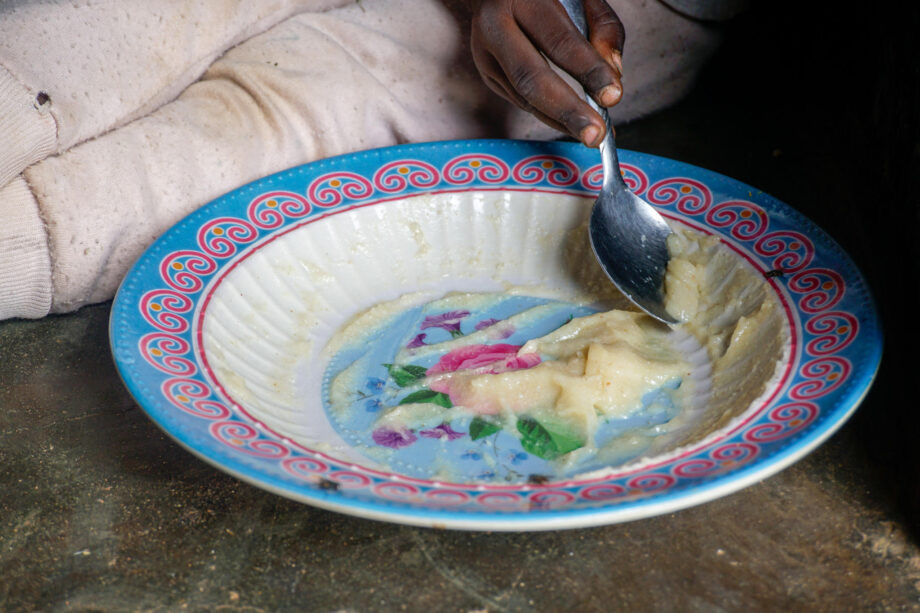
Tanayeishe Musau eats baobab porridge after school at his home in Mudzi, Zimbabwe, where the dish has become a daily staple amid worsening drought and hunger. Once a simple supplement, baobab porridge is now a primary meal for families like his, following widespread food shortages and the suspension of international aid.

BY LINDA MUJURU

This story was originally published by Global Press Journal.

Advertisement

Agnes Tauzeni stands on her parched field. She is a mother to two children, and is expecting another. But now, in a time that might otherwise have been joyful, her hopes wither like the struggling crops before her.


Three times she’s gambled on the rains; three times the sky has betrayed her. Her first two plantings failed. The soil was too dry to sustain life. Though her third attempt yielded a few weak shoots, they offered little promise of a meaningful harvest. El Niño-driven droughts have disrupted once-reliable rains, leaving Tauzeni’s family and many like hers struggling to feed themselves.

Advertisement


“I am always hungry,” Tauzeni says.


Advertisement

She worries about the health of her unborn child, based on how little nutrition she consumes herself.


Adding to this, food aid, previously funded by the US Agency for International Development, halted suddenly in January. That transformed what was already a struggle into a desperate battle for survival.

Advertisement


The food aid ended when US President Donald Trump, on his first day in office, issued an executive order that paused nearly all US foreign aid, most of which was administered by USAID. That agency is now all but defunct.


Advertisement

Food aid in Zimbabwe was an ongoing area of funding for USAID. In November 2024, the agency announced $130 million for two seven-year programs, implemented by CARE and Cultivating New Frontiers in Agriculture, that would provide food aid and other related support to areas of Zimbabwe most in need. The programs, which stopped, were just part of an ongoing slate of activities designed to help Zimbabwe’s neediest people.


About 7.6 million people in Zimbabwe — nearly half the country’s population — need humanitarian assistance, according to a 2025 UNICEF report. Of those, nearly 6 million, like Tauzeni, rely on subsistence farming.

Advertisement


Through the support of organizations with funding from USAID, people previously received cereals, edible seeds, oil and food vouchers.


Advertisement

“A sudden withdrawal can put the entire community in a dire situation,” says Hilton Mbozi, a seed systems and climate change expert.


Tauzeni recalls that her community used to receive food supplies such as beans, cooking oil and peanut butter to help combat malnutrition.

Advertisement


When Tauzeni got married in 2017, her fields promised abundance. Her harvests were plentiful, and her family never lacked food. Now, those memories feel like whispers from another world. The past two agricultural seasons, those harvests have been devastatingly poor.


Advertisement

With an empty granary and dwindling options, Tauzeni’s family survives on the same food every day: baobab porridge in the morning and sadza with wild okra in the evening. But Tauzeniworries whether even this will be on the table in the coming months.


“The little maize I have, I got after weeding someone else’s crops, but that won’t take us far,” she says.

Advertisement


Tauzeni says a 20-kilogram (44-pound) bag of maize costs US$13 in her village, an amount out of reach for her. Her only source of income is farming. When that fails, she has no money at all.


Advertisement

Hunger like Tauzeni experiences is widespread. Some families now eat just once a day.


Headman David Musau, leader of Musau village where Tauzenilives, says some people in his village did not plant any seeds this season, fearing losses due to the low rainfall. The government provides food aid inconsistently, usually 7 kilograms (15 pounds) of wheat per person for three months.

Advertisement


“It’s not enough, but it helps,” he says.


Advertisement

But without any other food aid, survival is at stake, he says. “People will die in the near future.”

 

Advertisement
Continue Reading
Click to comment

Leave a Reply

Your email address will not be published. Required fields are marked *

National

Government to equip Mpilo Hospital with radiotherapy machines funded by sugar tax initiative

Published

on

BY WANDILE TSHUMA 

Patients in Matabeleland North who rely on specialized care in Bulawayo are set to benefit from a major upgrade in cancer treatment facilities, as the government begins deploying equipment funded by the national sugar tax.

Advertisement

The Deputy Minister of Health and Child Care, Sleiman Timios Kwidini, confirmed to Parliament that the Treasury has released approximately $30.8 million to procure critical radiotherapy machines. Two low-energy units are earmarked for the country’s major referral centers, specifically Mpilo Central Hospital in Bulawayo and Parirenyatwa Hospital in Harare.

Advanced payments have been made to suppliers, and the government confirmed that installation is currently in progress alongside the preparation of specialized treatment bunkers. Kwidini described the move as a significant milestone intended to reduce patient waiting times and the costly need for referrals to facilities outside the country.

However, the announcement met with sharp criticism from lawmakers who argued the ministerial update lacked sufficient detail regarding the total revenue collected and the specific types of equipment purchased.

Advertisement

Surrender Kapoikilu led the debate, questioning whether the ministry had secured essential components like linear accelerators and diagnostic tools like endoscopes. He warned that without adequate surge protection, the high-tech equipment remains at risk from power fluctuations. “ZESA currents have many surges,” Kapoikilu said. “If you just plug it in, in five minutes, a machine is gone”.


He emphasized that effective treatment must begin with proper diagnosis, stating, “If you cannot diagnose cancer, you cannot conquer”.

Advertisement

The discussion expanded to include the dire state of basic patient care, with Corban Madzivanyika pointing out that referral centers often lack fundamental tools. “You get to the hospital and you are told that there is no wheelchair,” Madzivanyika told the House, describing the shortage of stretchers and wheelchairs as embarrassing.

Responding to the concerns, the Acting Speaker, Joseph Tshuma, directed the ministry to defer the matter and return with a more comprehensive dossier detailing the expenditure and the availability of essential medicines.


Advertisement

Continue Reading

National

Parliament weighs 40% community share in carbon credit deals

Published

on

BY NOTHANDO DUBE

Lawmakers in Zimbabwe are debating a comprehensive Climate Change Management Bill that supporters say will finally ensure rural communities are no longer “mere spectators” in the multi-billion dollar carbon credit industry.

Advertisement

The Bill, which moved into its second reading, seeks to regulate carbon trading and protect the country’s natural resources from foreign exploitation.

Mutsa Murombedzi delivered a passionate plea for the legislation, arguing that it is a matter of “justice, survival and the dignity of our people”. “Climate change is not a distant stone,” Murombedzi told the House. “It is the flood that we see in Chimanimani, which sweeps away our schools… the heatwave that scotches our communities in Hwange, one silent drought that empties our granaries”.

A major point of contention and hope is the proposed 40% community share in carbon projects. Lawmakers argued that previous projects often left locals with nothing but “tsotso stoves or bicycles” while profits were “repatriated back to their countries, particularly those from the global north”.

Advertisement

Master Makope applauded the move to bring transparency to a sector where deals were often done “without the knowledge of the authorities”.

“By having this policy framework, I believe our people are going to benefit,” Makope said.

“The Minister has to make sure that the villagers, the communities, should also have easy access to registration of their own projects because they are the ones who own these forests”.

Advertisement

The debate also focused on the establishment of a National Climate Fund.

Susan Matsunga insisted on rigorous oversight, suggesting a biennial reporting cycle to Parliament to ensure progress is measurable. “This is about building a culture of transparency that ensures our climate goals are not just promises on paper but measurable achievements,” Matsunga stated.

Murombedzi added that “Climate finance must not vanish into corridors in Harare; it must flow to the ward level where resilience is built”.

Advertisement

Continue Reading

Binga

Lawmaker urges localized climate strategies for Tsholotsho, Hwange

Published

on

BY NOKUTHABA DLAMINI

A Shamva South lawmaker has called for a radical shift in climate change mitigation strategies, demanding that the government abandon “one-size-fits-all” projects in favor of solutions that respect the unique geography and culture of districts like Tsholotsho, Hwange, and Binga.

Advertisement

During the debate on the Climate Change Management Bill, Joseph Mapiki argued that national programs often fail because they ignore local realities.

“We should look at our projects in terms of the area,” Mapiki told the National Assembly. “For example, in Tsholotsho and Hwange, where there are game parks, we cannot force them to do horticulture because there is no water. We should encourage them to engage in tourism”.

Mapiki also challenged the government’s staffing policies for climate initiatives, insisting that local language and cultural knowledge are essential for the success of any environmental committee.

Advertisement

“If someone from Mashonaland Central goes and is incorporated in a Committee in Binga, it means that the Committee will not function well because that person will not be conversant with the language,” he argued.

He further emphasized that “First preference should be given to the locals to avoid taking people from other areas… because those other people will not be aware of the language and culture of the people there”.

Beyond staffing and local projects, Mapiki raised concerns about the influence of international donors on Zimbabwe’s environmental policy.

Advertisement

He urged the government to ensure that the majority of climate funding is domestic to avoid “stringent measures and conditions” imposed by foreign entities.

“Our plea Hon. Minister, is that 98% funding for that Bill should be from Zimbabwe,” Mapiki stated.

“Foreign funding is hampering our progress”. His remarks were supported by other MPs who noted that climate change mainstreaming must include the “vulnerable communities” and “local authorities” who are on the frontlines of weather shocks in the province.

Advertisement

Continue Reading

Trending

Copyright © 2022 VicFallsLive. All rights reserved, powered by Advantage