BY GAMUCHIRAI MASIYIWA
Summary: The quiet return of maternity fees and the black-market sale of essential documents put extra burdens on mothers as they struggle to navigate a broken system.
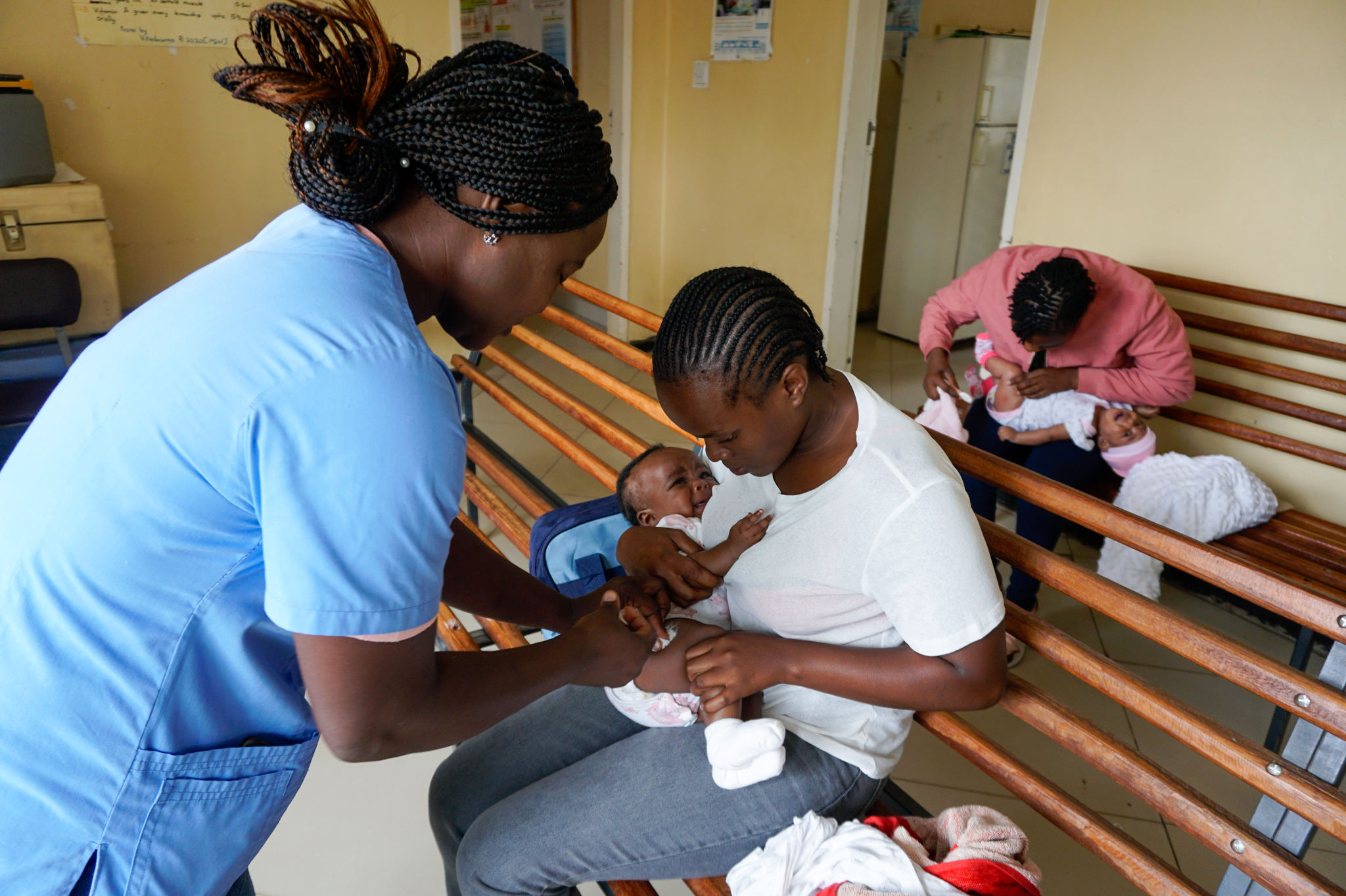
First-time mother Connie Jowastands with her 3-month-old baby nestled against her back, chatting with other mothers in line. Like many women at this crowded clinic in Harare’s Mabvuku suburb, Jowa is trying to get a Child Health Card, which was unavailable when she gave birth at a public hospital, and was still out of reach at her local clinic. Health cards are mysteriously out of stock.
But they can be bought under the table, if you know who to ask and are willing to pay.
Zimbabwe’s Child Health Cards, meant to be free to new mothers, are crucial documents that track babies’ growth, vaccinations and medical histories. Without them, each clinic visit becomes a reset button. Inquiry into the child’s medical history starts from scratch. Since July 2024, the cards have disappeared from health facilities across Harare’s central hospitals and 42 council clinics — even though the card’s producers say they’re making enough to meet demand. This artificial shortage has birthed a shadow market where clinic staff quietly sell this essential document to desperate mothers. This sort of nickel-and-dime bribery exposes deep cracks in a health care system that’s already failing the most vulnerable people.
What started as a clandestine operation has become an open secret.
“When cards arrive at a clinic, they’re kept by the sister in charge. But it’s usually nurse aides or junior staff who sell them, working in cahoots with other staff members,” says Simbarashe James Tafirenyika, who leads the Zimbabwe Municipality’s Nurses and Allied Workers Union.
Someone who sells 100 cards can pocket around US$500, she says, and none of that money goes to the government of the council.
The going rate for the Child Health Card is US$5, say several mothers who spoke to Global Press Journal.
Medical Histories on Scraps of Paper
When the system works as designed, every mother receives a Child Health Card when her baby is born. Now, most mothers must track their infants’ medical histories on scraps of paper.
Harare’s council clinics alone deliver more than 3,000 babies every month, with each mother left scrambling for documentation.
“I feel hurt,” Jowa says. “I want to know what vaccines my child has received and their purposes, but I just can’t get that information.”
A nurse aide assistant at one of the council clinics has witnessed this shadow market.
“If a nurse is selling, they ask the mother to be ‘skillful’ if they need the card,” says the assistant, who requested anonymity for fear of retribution. In Zimbabwe, “skillful” is a common euphemism for paying small bribes.
While the Ministry of Health and Child Care is supposed to supply the cards for free, Prosper Chonzi, the City of Harare’s director of health, admits supplies have been erratic for six months and that people have complained about being forced to purchase these cards. Clinic workers may be exploiting the known shortage and coordinating among themselves to sell the cards rather than providing them for free, he says.
“We can’t rule that out,” he says.
The card shortage coincides with the quiet return of maternity fees in public hospitals. Though not officially announced, hospitals have begun billing mothers after delivery — a policy change the government would neither confirm nor deny.
High Inflation, More Corruption
Between 2011 and 2024, more than 1 million pregnant women in the country delivered babies for free at health care clinics, under a scheme called results-based financing. Maternal mortality rates dropped during that time.
But these gains, partly achieved through better access to safe delivery services, face new hurdles as budget constraints and economic pressures reshape the health care landscape.
Even in 2021, a study from Transparency International Zimbabwe surveyed over 1,000 people in Zimbabwe and found that 74% had been asked to pay a bribe while trying to access health care services. A feeling of being underpaid amidst a deteriorating economy and high inflation was a key driver among health workers who solicitated bribes, which has been a rising trend, according to the study.
“The motivation for earning an extra income is strong especially in countries with a high rate of inflation,” the study states.
Zimbabwe’s health care system faces chronic challenges, including an exodus of health workers to other countries, inadequate funding, drug shortages, obsolete infrastructure and more. In 1991, the government introduced user fees across public institutions as part of an economic structural adjustment program. The government abolished the fees in 2011, only to partially reinstate them around 2013.
Prudence Hanyani, a community activist in Harare, says the reintroduction of user fees in public hospitals will burden women who already shoulder extra costs, like paying for midwives, so they can get better treatment when giving birth.
“Maternal health services should be free,” she says, “because giving birth is a service for the nation that contributes to the country’s population.”
Mothers Pay the Price
Valerie Shangwa, who gave birth four and a half months ago at a private maternity hospital, still has no card for her daughter.
“You know how difficult it is to keep a paper,” she says. “When nurses ask about last month’s weight, you end up guessing, and that distorts the whole record.”
Charlton Prickise, technical director at Print Flow, says his company sells Child Health Cards only to government-authorized health facilities and faces no shortages.
“The shortages mean health facilities simply aren’t coming to get them,” he says.
Though Print Flow hasn’t detected leaks, Prickise recalls finding other versions of this card on the market two years ago, possibly from a nongovernmental organization. Print Flow isn’t the sole supplier of the cards, and they haven’t received any government orders recently.
In a written response to Global Press Journal, Donald Mujiri, spokesperson for the Ministry of Health and Child Care, said the shortage of Child Health Cards is due to supply chain inefficiencies and insufficient donor funding. The cards, he says, are procured with government funding and aid from supporting partners such as the United Nations Children’s Fund. Nevertheless, Mujiri says, the ministry needs to strengthen the supply chain management system at all levels and proactively mobilize resources for procuring the cards.
Meanwhile, mothers wait — or pay the price. Faith Musinami, 26, delivered her daughter in July 2024. An orderly told her the clinic only had cards for boys, but if she wanted, they could organize one for US$5. Musinami had not budgeted for the cost. She sacrificed the last penny she had.
This story was originally published by Global Press Journal.






 Slider3 years ago
 National5 years ago
 Tourism and Environment4 years ago
 Special reports4 years ago
 Opinion4 years ago
 National4 years ago
 National3 years ago
 National3 years ago