Connect with us

National

Rest in peace? Not in Harare: Cemetery scandal sparks outrage

Published

on

BY STAFF REPORTER

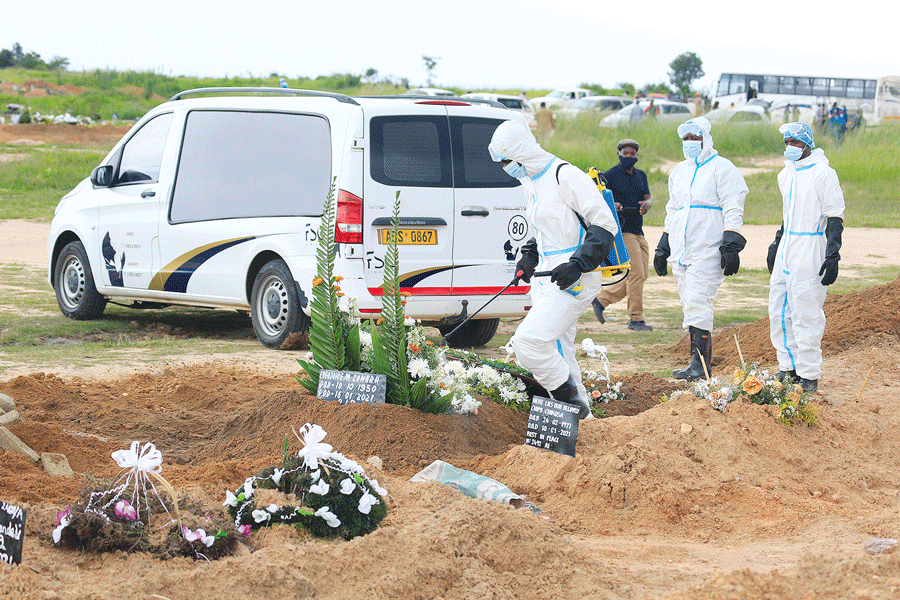
A disturbing scandal has rocked Harare, after four suspects were arrested for the massive desecration of approximately 380 graves and corpses at Restland Memorial Park in Rainham.

Advertisement

The alleged crimes, which occurred between 2015 and 2024, have left the community reeling in shock.

According to the Zimbabwe Republic Police (ZRP), the suspects – Edwin Muronzi, Tinashe Chiguma (32), Moses Gwanya (19), and Kudakwashe Humure (21) – were arrested after Tinashe Chiguma reported experiencing terrifying visions of dead people requesting to know the whereabouts of their relatives.

Chiguma implicated his employer, Edwin Muronzi, and his accomplices, leading to their arrest.

Advertisement

Investigations revealed a sinister plot, where Edwin Muronzi employed grave diggers, including the suspects, and paid them between $15 and $20 per grave.

The grave diggers were instructed to dig up existing graves to make way for new burials.

In the process, they would pack human skeletal remains into empty cement bags, wrap them in burial clothes, and dispose of them in a trench or dam behind the cemetery.

Advertisement

Traditional artifacts buried with the bodies were also callously discarded.

The suspects would then resell the desecrated graves to unsuspecting new clients, who were unaware of the grave reuse.

The ZRP is conducting a thorough investigation, including forensic analysis, to identify the affected graves, bodies, and relatives.

Advertisement

The police are appealing for information leading to the arrest of outstanding suspects, identified only as Kevy, Shumba, and Dread. Anyone with information can contact the National Complaints Desk or report to the nearest police station.


Advertisement
Continue Reading
Click to comment

Leave a Reply

Your email address will not be published. Required fields are marked *

National

Zimbabwe fast-tracks approval of long-acting HIV prevention drug Lenacapavir

Published

on

BY WANDILE TSHUMA

Zimbabwe has taken a major step in the fight against HIV following the rapid approval of Lenacapavir, a groundbreaking long-acting injectable for HIV pre-exposure prophylaxis (PrEP). The Medicines Control Authority of Zimbabwe (MCAZ) authorised the drug in just 23 days, marking one of the fastest regulatory approvals in the country’s history.

Advertisement

The application, submitted by pharmaceutical company Gilead Sciences in October, underwent an expedited review because of its public health importance. MCAZ says the fast-tracked process did not compromise scientific scrutiny, with the product subjected to a rigorous assessment of its safety, efficacy and quality.

Lenacapavir is designed for adults and adolescents weighing at least 35kg who are HIV-negative but at substantial risk of infection. Unlike traditional daily oral PrEP, the medicine is administered as a six-monthly injection, following an initiation phase that includes one injection and oral tablets on Days 1 and 2. Health authorities say this long-acting formulation could dramatically improve adherence and expand prevention options, particularly for communities where daily pill-taking is difficult.

MCAZ Director-General  Richard T. Rukwata described the approval as a landmark moment in Zimbabwe’s HIV response.

Advertisement

“The rapid approval of Lenacapavir reflects MCAZ’s dedication to accelerating access to trusted, high-quality health products. This milestone brings new hope for HIV prevention and reinforces our commitment to safeguarding public health,” he said.

To fast-track the process, the Authority applied a regulatory reliance approach, drawing on scientific assessments from the World Health Organization’s Prequalification Programme (WHO PQ). This allowed evaluators to build on internationally recognised review processes while ensuring Zimbabwe’s own standards were met.

The introduction of Lenacapavir comes as Zimbabwe continues efforts to reduce new HIV infections, particularly among young people and key populations who face barriers to consistent PrEP use. Public health experts say the drug’s twice-yearly dosing could be a game changer in improving uptake and protection.

Advertisement

MCAZ says it remains committed to ensuring Zimbabweans have access to safe, effective and good-quality medical products, in line with its mandate under the Medicines and Allied Substances Control Act.

Advertisement
Continue Reading

National

Zimbabwe makes gains against TB

Published

on

BY WANDILE TSHUMA

The World Health Organization (WHO) data show that Zimbabwe continues to make measurable gains in its fight against tuberculosis (TB).

Advertisement

According to the Global Tuberculosis Report 2025, Zimbabwe’s estimated TB incidence has declined to 203 per 100,000 population, representing a 3.8 % reduction from 2023. The report states that “TB incidence in Zimbabwe has fallen to 203 per 100 000, a 3.8 % reduction from 2023.” 

On treatment outcomes, the country’s overall success rate for all forms of TB has improved to 91 %, up from 89 % in 2023. The report quotes: “Treatment success for all forms of TB has improved to 91 %, up from 89 % in 2023.” 

For drug-resistant TB (DR-TB), progress has also been recorded: treatment success rose from 64 % for the 2021 cohort to 68 % for the 2022 cohort. As the report notes: “treatment success for drug-resistant TB increased from 64 % for the 2021 cohort to 68 % for the 2022 cohort.” 

Advertisement

In the critical sphere of TB‐HIV co-infection, Zimbabwe saw a drop in the co‐infection rate to 49 %, down from 51 %. The report states: “TB/HIV co-infection rates have fallen to 49 %, down from 51 %.” 

Zooming out, the 2025 global report shows that across the world TB is falling again, although not yet at the pace required to meet targets. Globally, incidence declined by almost 2 % between 2023 and 2024, and deaths fell around 3 %. 

However, the report warns that progress is fragile. Funding shortfalls, health-system disruptions (especially during the COVID-19 era), and the ongoing challenge of drug-resistant TB threaten to erode gains. The WHO page reminds that the 2025 edition “provides a comprehensive … assessment of the TB epidemic … at global, regional and country levels.” 

Advertisement

For example, although more people are being diagnosed and treated than in previous years, not enough are being reached with preventive interventions, and many countries are still far from the targets set under the End TB Strategy.


Advertisement
Continue Reading

National

Government extends Victoria Falls Border Post operating hours to 24 hours

Published

on

BY WANDILE TSHUMA

The government has officially extended the operating hours of the Victoria Falls Border Post to a full 24-hour schedule, according to an Extraordinary Government Gazette published on Thursday.

Advertisement

The change was announced under General Notice 2265A of 2025, issued in terms of section 41 of the Immigration Act [Chapter 4:02]. The notice states that the Minister of Home Affairs and Cultural Heritage has approved the extension with immediate effect from the date of publication.

The Gazette declares:

“It is hereby declared that in terms of section 41 of the Immigration Act [Chapter 4:02], the Minister has extended the operating hours for the Victoria Falls Border Post to twenty-four (24) hours on a daily basis, with effect from the date of publication of this notice.”

Advertisement

The move is expected to boost tourism, trade, and regional mobility along one of Zimbabwe’s busiest tourist corridors, which connects the country to Zambia and the broader SADC region.

Stakeholders in tourism and logistics have long advocated for extended operating hours, citing increased traffic through Victoria Falls and the need to align with neighbouring countries that already run round-the-clock border operations.


Advertisement

Continue Reading

Trending

Copyright © 2022 VicFallsLive. All rights reserved, powered by Advantage