Connect with us

Tourism and Environment

VFWT rescues buffalo and baby elephant

Published

on

BY BAYANDA TSHUMA

In a heartwarming display of compassion and expertise, the Victoria Falls Wildlife Trust (VFWT) team sprang into action to save not one, but two incredible creatures in distress of wire snares.

Advertisement

On Monday, a distressed adult male buffalo was spotted trapped in a wire snare around its neck in the Victoria Falls National Park.

“Thanks to a crucial call from the Zambezi Horse Safaris IMPI unit, we were able to swiftly act and tranquilize the buffalo, safely remove the snare, and release him back into the wild—snare-free,” the trust said.

“The snare hadn’t cut deeply, so the buffalo is expected to make a full recovery.”

Advertisement

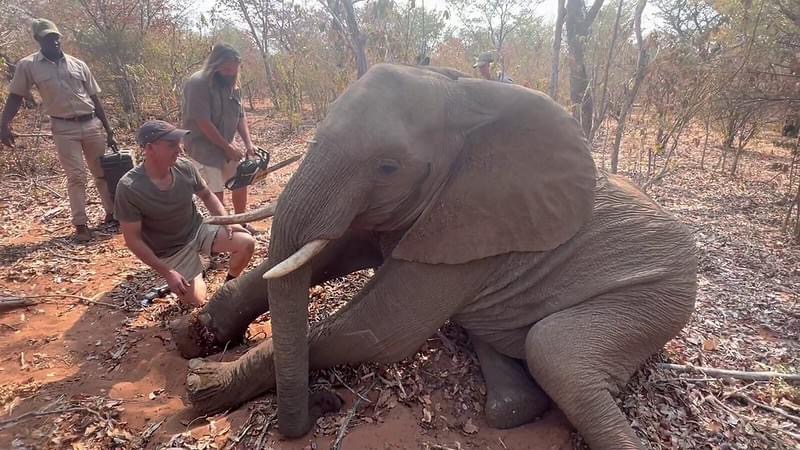
And just days before, they came to the aid of a young elephant, suffering from a severe cable snare injury that had left him in agony.

“We were able to dart the elephant, carefully remove the snare, and provide essential treatment for his wounds,” the trust explained.
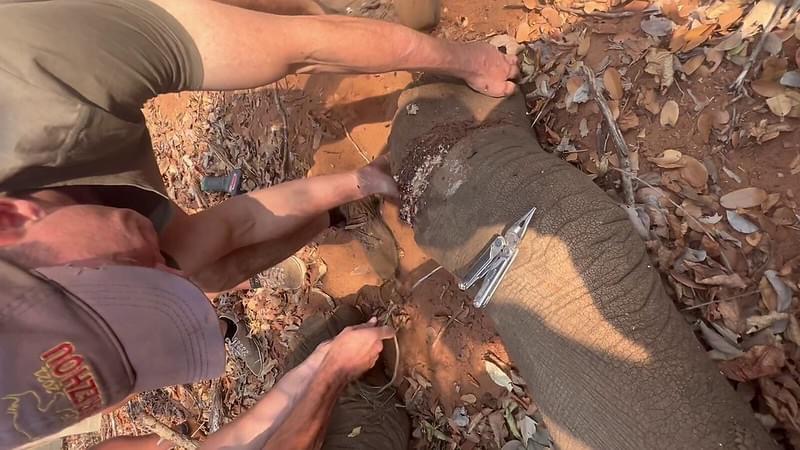
“After thorough care, we released him back into the wild, hopeful for a full recovery.”

Advertisement

The trust’s dedication to wildlife conservation and their tireless efforts to protect and preserve the precious animals of Victoria Falls National Park are truly inspiring.

“A huge thank you to Zimparks (Zimbabwe Parks and Wildlife Management Authority) and the Zambezi Horse Safaris IMPI Unit for their quick response and invaluable assistance,” they said. “Your dedication helps us protect and save our wildlife!”

As the trust reminds us, “If you spot any signs of poaching or suspicious activities, report them immediately to the authorities. Together, we can make a difference in safeguarding our precious wildlife.”
Advertisement

Continue Reading
Click to comment

Leave a Reply

Your email address will not be published. Required fields are marked *

Slider

Painted Dog Conservation raises alarm over road detour threatening wildlife near Hwange

Published

on

BY NOKUTHABA DLAMINI 

Painted Dog Conservation (PDC) has raised serious concerns over a road rehabilitation detour near Hwange National Park, warning that the route now passing through a sensitive wildlife area poses an immediate threat to painted dogs and other species.

Advertisement

In a statement shared on its official Facebook page, PDC said while it supports Zimbabwe’s ongoing road rehabilitation programme, the decision to divert heavy commercial traffic through an ecologically critical landscape is placing wildlife and people at risk.

The organisation said it had, together with other conservation groups and tourism operators, raised concerns with the relevant authorities, the responsible ministry and the contractor from the early stages of the project, warning of potential ecological damage. However, those concerns were not acted upon, and the detour is now in active use.

According to PDC, the increased traffic volume and speeding trucks along the route leading to Hwange National Park have created a “grave and immediate danger” to painted dogs, one of Africa’s most endangered carnivores, as well as to other wildlife and road users.

“With the detour now in place, the reality on the ground is worrying,” the organisation said.

Advertisement

PDC revealed that its teams, alongside other conservation stakeholders, are taking emergency measures to reduce wildlife fatalities during the period. These include actively guiding painted dogs away from the road and, in some cases, chasing them to safety when trucks approach. Staff have also been stationed along the road holding “Slow Down” placards to alert motorists.

“These are not ideal or sustainable solutions, but they are necessary right now to save lives,” the organisation said.

Painted Dog Conservation has called on authorities to urgently install additional wildlife warning signage and more speed humps to calm traffic through the sensitive area. The organisation also appealed directly to motorists to exercise caution.

Advertisement

“We respectfully urge all road users to slow down, stay alert, and remember that this is a shared landscape. Development and conservation must go hand in hand, especially in areas of such high ecological importance,” PDC said.

The organisation stressed that wildlife cannot speak for itself and vowed to continue intervening until safer, long-term solutions are implemented.

PDC has also urged the public to share the message widely in a bid to help protect Hwange’s wildlife.

Advertisement

Continue Reading

Slider

Human-wildlife conflict in Zimbabwe is a crisis: who is in danger, where and why?

Published

on

BY BLESSING KAVHU

In the fishing villages along Lake Kariba in northern Zimbabwe, near the border with Zambia, everyday routines that should be ordinary – like collecting water, walking to the fields or casting a fishing net – now carry a quiet, ever-present fear. A new national analysis shows that human-wildlife conflict in rural Zimbabwe has intensified to the point where it has become a public safety crisis, rather than simply an environmental challenge.

Advertisement

Between 2016 and 2022, 322 people died in wildlife encounters. Annual fatalities climbed from 17 to 67: a fourfold increase in just seven years. These fatal encounters are concentrated in communities that live closest to protected areas and water bodies. Here, people and wildlife compete for space and survival.

Protected areas and rivers provide water, forage and shelter for wildlife. Rural households rely on the same landscapes for farming, fishing and domestic water. The study shows that this overlap between human activity and wildlife movement sharply increases the risk of fatal encounters.

Historically, human-wildlife conflict research and policy in southern Africa focused on economic losses such as destroyed crops, livestock predationand damaged infrastructure. Fatal attacks on people were often treated as rare or incidental. This study shifts that perspective by showing that human deaths are not isolated events, but a growing and measurable pattern that demands urgent attention.

Advertisement

I am a US-based Zimbabwean scientist working with Zimbabwean conservationists. We analysed national wildlife-related fatality records from the Zimbabwe Parks and Wildlife Management Authority. The central questions were: how many people are dying from wildlife encounters, where are these deaths occurring and which species are responsible?

The findings were stark. Fatal encounters are rising rapidly, are geographically clustered in the north and western districts, and are driven primarily by two species: crocodiles and elephants (not lions, as people might expect). The implications extend beyond conservation to include trauma, fear, retaliatory killings of wildlife and the need for targeted, locally specific interventions.

Patterns in the data

The study reveals that more than 80% of recorded deaths involved only two species, elephants and crocodiles. Crocodiles alone were responsible for slightly more than half of all fatalities. Many of these incidents happened during activities people cannot avoid: fishing, crossing rivers, bathing, or washing clothes in rivers and lakes. These encounters are sudden and often impossible to anticipate, especially in places where visibility is poor and safe water access is limited.

Advertisement

Elephants were responsible for nearly a third of the deaths. These happened mainly during crop-raiding incidents or when communities attempted to chase elephants from fields and homesteads, or when people were walking to school and work. These confrontations often occur at night or in the early morning when visibility is low. Lions, hyenas, hippos and buffalo contributed only 17% of fatal incidents during the study period.

The rise in lethal encounters appears to be driven by several overlapping forces. Zimbabwe still holds one of Africa’s largest elephant populations, estimated at over 80,000 animals. This is second only to Botswana. In dry years elephants move over long distances in search of water and forage, increasing their presence in communal lands. Shrinking natural habitats and growing rural populations mean that human populations are expanding into wildlife corridors. Climate change, particularly recurring droughts, intensifies the competition for water and space.

The geography of the fatalities reveals a clear pattern. Most deaths occurred in Kariba, Binga and Hwange. These are districts along the country’s northern and western frontier, with a combined population of about 343,264 people. They have large water bodies that support abundant crocodile populations; they are close to protected areas with high elephant numbers; and people there depend heavily on farming, fishing and natural resource use.

Advertisement

How people feel

These encounters leave people with fear. Parents become anxious about children walking to school, farmers worry about tending crops at dawn and communities may avoid crossing rivers.

But people aren’t getting mental health support. So grief and fear can turn into anger, often resulting in killings of wildlife. A destructive cycle undermines conservation and damages trust between communities and authorities.

What to do about it

Different places face different dangers, and solutions should reflect that.

Advertisement

Areas near crocodile-prone rivers need safe water access and crossing points and redesigned community washing areas. Districts where elephants are responsible for most fatalities require better early-warning systems, community-based monitoring networks and low-cost methods to deter elephants from crop fields. These measures must be paired with community education and consistent follow-up support.

The findings highlight that coexistence will not be possible without recognising the emotional and psychological dimensions of living alongside wildlife. The responsibility lies with government agencies working with communities. These must be supported by conservation organisations and health services. Counselling, community healing processes and long-term engagement can help break the retaliatory cycle.

Research from other African settings shows that targeted solutions grounded in community involvement and local risk patterns are key to reducing conflicts. In northern Kenya, community-based early warning systems that alert villagers to elephant movements have significantly reduced fatal encounters. Beehive fences and chili-based barriers have helped protect crops without harming wildlife.

Advertisement

In Uganda’s Murchison Falls area, surveys found that local people preferred physical exclusion measures and the relocation of specific crocodiles as ways to lower the risk of attacks. In South Sudan’s Sudd wetlands, communities identified crocodile sanctuaries as one way to reduce dangerous interactions. In Zambia’s lower Zambezi valley, villagers highlighted the need for more alternative water access points (such as boreholes).

These examples show that fatal encounters are not inevitable. When interventions are matched to the species involved and the daily realities of local communities, both human deaths and retaliatory killings of wildlife can be reduced.

Zimbabwe’s wildlife remains a source of national pride and a cornerstone of tourism. But conservation cannot succeed if the people who live closest to wildlife feel unprotected or unheard. A future where people and wildlife thrive together depends on acknowledging that human wellbeing is inseparable from the wellbeing of the ecosystems they share.

Advertisement

SOURCE: THE CONVERSATION 

Advertisement
Continue Reading

Slider

Conservation’s unfinished business

Published

on

BY RHETT AYERS BUTLER

SUMMARY:

Advertisement
  • A recent Nature paper argues that many persistent failures in conservation cannot be understood without examining how race, power, and historical exclusion continue to shape the field’s institutions and practices.
  • The authors contend that conservation’s colonial origins still influence who holds decision-making authority, whose knowledge is valued, and who bears the social costs of environmental protection today.
  • As governments pursue ambitious global targets to expand protected areas, the paper warns that conservation efforts risk repeating past injustices if Indigenous and local land rights are not recognized and upheld.
  • To address these challenges, the authors propose a framework centered on rights, agency, accountability, and education, emphasizing that more equitable conservation is also more durable.

Conservation often presents itself as a technical enterprise: how much land to protect, which species to prioritize, what policies deliver results. A recent paper in Nature argues that this framing misses something fundamental. Many of the field’s most persistent failures, the authors contend, cannot be understood without confronting how race, power, and historical exclusion continue to shape conservation practice today.

The paper, A Framework for Addressing Racial and Related Inequities in Conservation, does not claim that conservation is uniquely flawed, nor that injustice is universal across all projects. Its argument is narrower and more pointed. Modern conservation, it says, emerged from a colonial context that treated land as empty and people as obstacles. Those assumptions were never fully dismantled. They survive in subtler forms, influencing whose knowledge counts, who bears the costs of protection, and who decides what success looks like.

The authors, led by Moreangels Mbizah of Wildlife Conservation Action in Zimbabwe, trace conservation’s institutional roots to the late nineteenth century, when protected areas were established across colonized landscapes through forced removals and restrictions on customary land use. Indigenous peoples and rural communities were often excluded in the name of preserving “pristine” nature. Although conservation has evolved since then, the paper argues that these early patterns still shape present-day practice through what it calls “path dependencies”: inherited norms that continue to privilege outside expertise and centralized control.

One consequence, according to the authors, is the persistent marginalization of Indigenous peoples and local communities, particularly in the Global South. These groups are frequently described as “stakeholders” or “beneficiaries” rather than rights-holders with authority over their lands. The language may sound neutral, the paper suggests, but it often masks unequal power relationships. Even well-intentioned projects can reproduce older hierarchies if communities are consulted only after priorities are set, or if participation is limited to implementation rather than decision-making.

Advertisement

The paper pays particular attention to the current push to expand protected areas to cover 30% of the planet by 2030. In principle, the authors argue, this target could support more pluralistic forms of conservation, including Indigenous-managed territories and community conservancies. In practice, they warn, countries lacking legal mechanisms to recognize customary land rights may default to state-led models that repeat earlier injustices. Conservation success, measured narrowly through ecological indicators, can come at high social cost when human rights are treated as secondary concerns.

Another theme the authors examine is the way conservation narratives value animals and people. Campaigns aimed at audiences in Europe and North America often focus on the moral worth of individual animals, sometimes in ways that implicitly devalue the lives of people who live alongside wildlife. When human–wildlife conflict results in injury or death, local suffering may receive little attention, while the killing of a charismatic animal can provoke global outrage. The authors argue that such asymmetries are not incidental; they reflect deeper processes of “othering” that shape whose lives are seen as grievable or deserving of protection.

The paper is careful not to frame these dynamics as purely racial in a narrow sense. Instead, it emphasizes intersections of race, class, geography, and political power. Urban elites in low-income countries, the authors note, may exercise authority over rural communities in ways that mirror global North–South inequalities. Conservation led by local actors is not automatically just. What matters is how power is distributed and whether affected communities retain meaningful agency.

To address these patterns, the authors propose what they call the RACE framework: Rights, Agency, Challenge, and Education. The framework is not presented as a checklist or a universal solution. Rather, it is intended as a lens through which conservation organizations, researchers, and funders might examine their own practices.

Advertisement
The RACE model for conservation

Rights, in this framing, are foundational. The paper argues that conservation cannot be sustainable if it undermines basic human rights, including rights to land, culture, and self-determination. Agency follows from this: communities must have real authority over decisions that affect their territories, not merely advisory roles. Challenge refers to the obligation, particularly among powerful institutions and individuals, to speak out when conservation practices cause harm or exclusion. Education, finally, involves confronting conservation’s own history and recognizing knowledge systems that exist outside Western scientific traditions.

The authors stress that this is not about revisiting past wrongs for their own sake. Understanding history, they argue, is necessary to avoid repeating it under new banners. Nor is the framework framed as an attack on conservation itself. On the contrary, the paper insists that conservation outcomes are likely to be stronger when communities closest to the land are recognized as stewards rather than obstacles.

There is a pragmatic strand running through the analysis. Conservation, the authors note, increasingly operates in a politically fragmented world, with declining public funding and growing skepticism toward international institutions. Projects that lack local legitimacy are more vulnerable to conflict and reversal. Addressing inequities, in this sense, is not only an ethical concern but also a strategic one.

Advertisement

The paper does not pretend that change will be easy. Power, once accumulated, is rarely surrendered voluntarily. Nor does it suggest that conservation can resolve broader social injustices on its own. Its claim is more modest, and perhaps more demanding: that conservation must stop treating inequality as an external issue and recognize how deeply it is woven into the field’s own structures.

For a discipline accustomed to measuring success in hectares and population counts, this is an uncomfortable proposition. But the authors’ central point is straightforward. Conservation is about relationships—between people and nature, and among people themselves. Ignoring those relationships does not make them disappear. It only ensures that their consequences are felt later, often by those with the least power to absorb them.

SOURCE: MONGABAY

Advertisement


Advertisement
Continue Reading

Trending

Copyright © 2022 VicFallsLive. All rights reserved, powered by Advantage