Connect with us

Slider

Southern Africa’s Sustainable Use Coalition slams CITES CoP20 decisions as “punishing success” and “killing with kindness”

Published

on

BY NOKUTHABA DLAMINI 

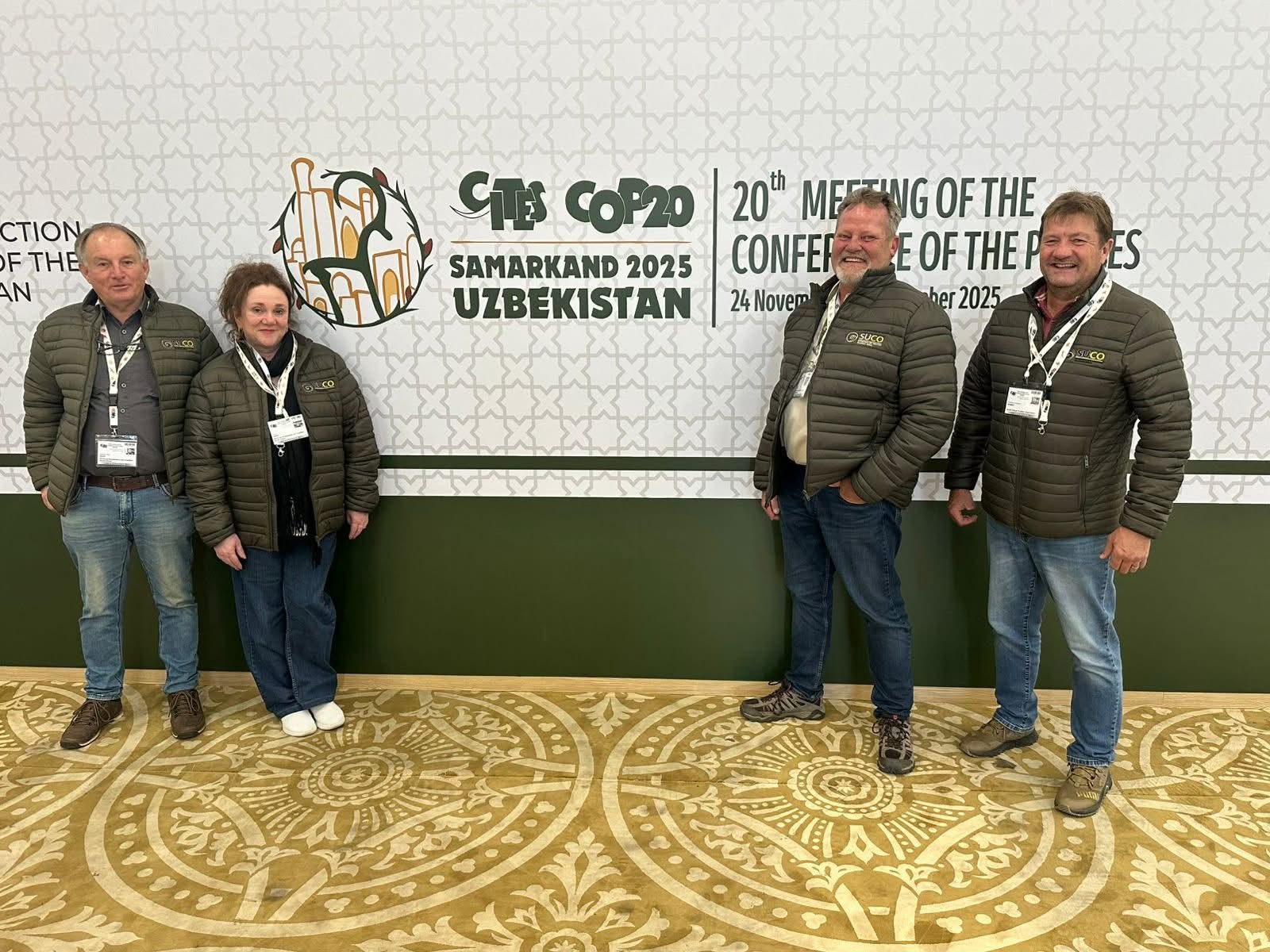
The Sustainable Use Coalition Southern Africa (SUCo-SA) has issued two strongly worded statements criticising decisions made at the CITES CoP20 conference in Uzbekistan, accusing Parties of undermining conservation success in southern Africa and ignoring evidence from range states.

Advertisement

In the first statement, SUCo-SA Vice Chair and the Confederation of Hunters Association of South Africa CEO Stephen Palos condemned the vote rejecting a proposal to remove the abundant southern giraffe from Appendix II. The proposal received 49 votes in favour, 48 against and 38 abstentions — including the 27-member EU bloc — falling short of the two-thirds majority required.

Palos called the outcome “yet another travesty of justice at the CITES CoP,” arguing that the decision reflects “a world dominated by an emotion before science philosophy in conservation.”

He singled out opposition from several African countries, saying:

Advertisement

“The most vocal objections made came from African countries with shocking records in conservation… where poaching, conflict, poverty, and desperation have decimated their wildlife, and now sell their souls to global anti-use/animal-rightist NGOs.”

Palos said the Chair “overlooked Eswatini and allowed none of the observer organisations an opportunity to speak,” forcing South Africa to call for a vote despite having “superbly presented” the proposal.

According to SUCo-SA, evidence showed that southern giraffe populations in Angola, Botswana, Eswatini, Malawi, Mozambique, South Africa, Zambia and Zimbabwe are “overwhelmingly increasing, with only one population reported as stable, and not a single population showing decline.”

Advertisement

The statement said this success is the result of “decades of effective national legislation, management frameworks, investment by private and community custodians, and sustainable-use incentives.”

But SUCo-SA argues that countries with no giraffe populations or poor conservation performance are influencing decisions that harm nations managing wildlife successfully.

“Once again, CITES (Convention on International Trade in Endangered Species of Wild Fauna and Flora) has managed to punish success and reward failure in conservation. And real people in southern Africa pay the price in hunger and deprivation.”

Advertisement

SUCo-SA: CITES Parties “killing with kindness” on rhino horn and ivory

In a second statement titled “CITES Parties Killing with Kindness at CoP20 – Rhino Horn & Ivory,” the SUCo-SA Executive criticised what it described as a predictable pattern where CITES Parties praise southern African conservation results while refusing to support related proposals.

The coalition said:

Advertisement

“They start by congratulating southern African range states for their ‘outstanding successes’… And then, without pause, they immediately announce that they will not support the proposal.”

The statement argued that many countries rejecting downlisting proposals come from regions where rhino or elephant populations have “collapsed or are entirely absent,” and that 47 years of trade bans and demand-reduction campaigns have failed.

“If 47 years of demand-reduction campaigns and trade bans have not saved rhino or elephants, at what point do we acknowledge that this approach is not working?” the coalition asked.

Advertisement

The statement questioned the positions of the EU, UK and USA, asking why they continue to “punish African conservation successes while rewarding failures” and why they “elevate the views of non-range states and discount the data, management systems, and lived realities of the countries that actually protect these species on the ground.”

According to SUCo-SA, southern African countries deserve practical support, not diplomatic praise that leads to policy obstruction.

“In the most diplomatic but patronising manner, southern African countries are told, in effect, to ‘go to hell, but enjoy the trip.’ This is what we mean when we say they are killing with kindness.”

Advertisement

The coalition said African states are “not asking for applause; they are asking for recognition of proven results” and the policy space to continue what works.

The statement concludes with a challenge to the global convention:

“CITES must decide whether it wants to remain a forum guided by evidence and sovereignty, or one led by political theatre and external pressure. The future of rhino and elephant conservation depends on that choice.”

Advertisement

Continue Reading
Click to comment

Leave a Reply

Your email address will not be published. Required fields are marked *

Hwange

Hwange Central finally receives long-awaited CDF funds

Published

on

BY NOKUTHABA DLAMINI

Hwange Central constituency has finally received its long-awaited Constituency Development Fund (CDF) allocation, marking the first disbursement since 2022, Member of Parliament for the area, Fortune Daniel Molokele, has confirmed.

Advertisement

In a statement, Molokele said an amount of ZiG 1.3 million was deposited last week into a special bank account set up exclusively to administer CDF funds for the constituency. The disbursement falls under the 2024 national budget, following confirmation from the Parliament of Zimbabwe that no CDF disbursement will be made under the 2023 national budget.

He further noted that there is still no clarity on when CDF allocations under the 2025 and 2026 national budgets will be released.

“With this development, our local CDF Committee will, during the coming week, initiate the process of rolling out the approved projects,” said Molokele.

Advertisement

Priority Wards and Projects

The initial phase of implementation will cover five wards, namely Wards 1, 4, 5, 6 and 14, with the remaining wards expected to benefit under the next CDF disbursement.

According to minutes from a public consultation meeting held on 13 April 2024 at St Ignatius Primary School in Hwange, the community unanimously prioritised solar-powered boreholes with JoJo tanks and fenced nutritional gardens as the flagship project for the 2024 CDF cycle.

Advertisement

The project is set to be implemented at the following locations:

  • Ward 1: Chibondo
  • Ward 4: Baghdad
  • Ward 5: Empumalanga
  • Ward 6: Phase Four
  • Ward 14: Ngumija

Other proposals discussed at the meeting included the construction of an Advanced Level laboratory science facility at Nechilisa Secondary School and the refurbishment of Nengasha Stadium, but these were deferred in favour of addressing water and food security.

CDF Committee in Place

The public meeting also elected a new 2023–2028 CDF Committee, comprising:

Advertisement
  • Alice Phiri (Trade Unions, Women and Local Communities)
  • Luka Katako (Traditional Leaders and Faith-Based Leaders)
  • Bryan Nyoni (Youth and Local Communities)
  • Shonipai Muleya (Finance and Accounting)

Francisca Ncube was nominated as the National Assembly representative, while Teresa Kabondo will represent the constituency in the Senate.

The CDF bank account signatories and procurement committee members include Molokele, Luka Katako, Thulani Moyo and Alice Phiri.

Funding Clarifications

Although earlier discussions indicated that the 2024 allocation would include outstanding funds from 2023—bringing the total to an estimated USD100 000, to be disbursed in ZiG at the interbank rate—the Speaker of Parliament later clarified that the 2023 CDF allocation was no longer available.

Advertisement

“As a result, each constituency ended up receiving ZiG 1.3 million, which was meant to be equivalent to USD50 000,” Molokele explained, adding that the approved projects were subsequently endorsed by the relevant Parliamentary committee.

He also confirmed that no CDF proposals have yet been submitted for 2025 and 2026.

Residents seeking further information have been advised to contact CDF Committee Secretary Thulani Moyo on 078 648 3659.

Advertisement

Molokele said at least two public feedback meetings will be held once implementation begins, to ensure transparency and accountability in the use of the funds.

Advertisement
Continue Reading

National

Education ministry launches nationwide one laptop, one iPad per pupil program

Published

on

BY LWAZI SHOKO

Zimbabwe has launched a nationwide One Laptop, One iPad Per Pupil initiative aimed at bridging the digital divide and expanding access to technology in schools, Minister of Primary and Secondary Education Torerayi Moyo announced on X on Monday.

Advertisement

The programme, being implemented in partnership with UNICEF Zimbabwe, will see the distribution of ICT equipment including laptops, tablets and projectors to schools across the country, with priority given to disadvantaged and solar-powered schools.

According to Minister Moyo, the initiative is designed to strengthen digital teaching and learning while promoting inclusive and equitable education. He said the programme seeks to ensure that all learners, regardless of geographic location or socio-economic background, have access to modern learning tools.

“As part of this initiative, I had the honour of presiding over the official handover of a major consignment of ICT devices,” Moyo said, adding that the resources would support the delivery of quality education and help prepare learners for a technology-driven future.

Advertisement

The minister described the programme as a transformative step that goes beyond the provision of devices, framing it as an investment in equity, opportunity and long-term national development.

Moyo also paid tribute to President Emmerson Dambudzo Mnangagwa, crediting his leadership under Vision 2030 and the Presidential Computerisation Programme for driving innovation and public-private partnerships in the education sector.

“By placing a laptop and an iPad in the hands of every pupil, we are building the digital foundations of a knowledge-based economy,” he said.

Advertisement

Lastly, expressed gratitude to UNICEF Zimbabwe and other development partners for their continued support, noting that the collaboration is key to building a more connected and future-ready education system.


Advertisement
Continue Reading

In the community

Two artisanal miners die in Umguza mine shaft collapse

Published

on

BY STAFF REPORTER 

Two artisanal miners have died following the collapse of a flooded mine shaft at Cement Side in Umguza District, ZBC has reported.

Advertisement

The incident occurred early Tuesday morning after heavy water ingress caused the shaft to give way, trapping the two men underground.

When rescue teams arrived at the scene, officers from the Bulawayo Fire and Ambulance Services Department, assisted by local volunteers, were leading recovery efforts.

A survivor of the incident, Khulumani Nkomo, described the terrifying moments leading up to the collapse.

Advertisement

“We heard a loud cracking sound as we reached the ground, then water started rushing in. The two were behind us, and the shaft just closed, trapping the other one in the tunnel,” he said.

Nkomo added that attempts to rescue the trapped miners proved futile.

“We tried to dig with our hands and tools, but the water kept coming. By the time help arrived, it was already too late.”

Advertisement

A brother of one of the deceased miners said the family is struggling to cope with the loss, revealing that the victim was only 19 years old.

Advertisement
Continue Reading

Trending

Copyright © 2022 VicFallsLive. All rights reserved, powered by Advantage