Connect with us

National

Mwonnzora suspends Khupe as MDC-T feud gets ugly

Published

on

BY NOKUTHABA DLAMINI

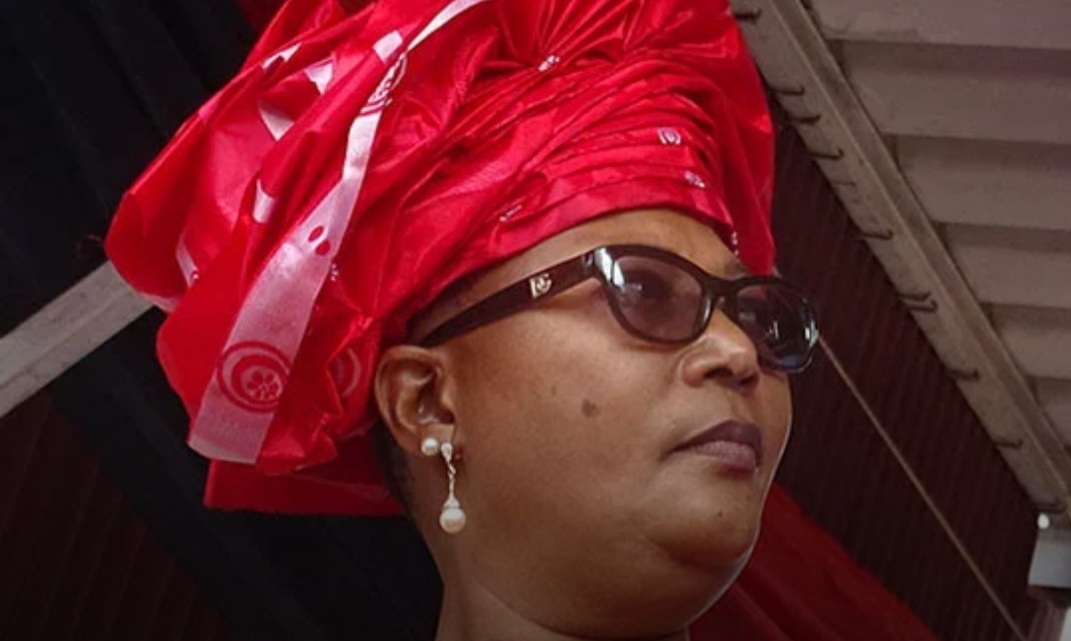
MDC-T on Thursday said it has suspended its deputy president Thokozani Khupe and her top ally Khaliphani Phugeni as the tussle for the control of the fringe opposition party intensifies.

Advertisement

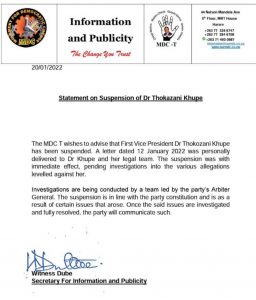
The Douglas Mwonzora led outfit announced Khupe’s suspension that was allegedly made on January 12 in a brief press statement.

Elsewhere, the party’s spokesperson Witness Dube told an online publication that Phugeni, a senator who was only appointed last year to replace an MDC Alliance legislator that was recalled by Mwonzora, had also been suspended.

The announcements followed an invitation to journalists by Khupe’s team to a press conference that she will reportedly address in Bulawayo on Friday.

Advertisement

“The suspension was with immediate effect, pending investigations into the various allegations levelled against her,” MDC-T said in the statement signed by Dube.

“Investigations are being conducted by a team led by the party’s arbiter General and the suspension is in line with the party constitution.

“This is a result of certain issues that arose. Once the said issues are investigated and fully resolved the party will communicate such.”
Advertisement

The former Makokoba MP’s lawyer Nqobani Sithole told another online publication that the suspension was “null ad void.”

Sithole argued that Mwonzora had expelled himself from the MDC-T after he wrote a letter to the Zimbabwe Electoral Commission saying he was leader of the MDC Alliance.

In December last year, Khupe took Mwonzora to the High Court seeking to block alleged attempts to recall her from Parliament.

Advertisement

The former deputy prime argued in court papers that MDC-T’s standing committee had passed a resolution in November 2021 to recall her and other officials from Parliament and local government positions.

Khupe and Mwonzora, who reuinited in 2020 after a controversial Supreme Court ruling that nullified Nelson Chamisa’s succession of the late Morgan Tsvangirai as leader of the original MDC, were behind the mass recall of MDC Alliance legislators and councillors.

The duo, however, fell out spectacularly after the party held its controversial extraoridnary congress in December 2021.

Advertisement

Khupe accused Mwonzora of rigging the elections that landed him the top post.

The party says it will hold its elective congress in March.

Since emerging as the party leader Mwonzora has expressed an interest to work with President Emmerson Mnangagwa and his ruling Zanu PF party.

Advertisement

He has met Mnangagwa twice at State House.

His critics accuse him of hobnobbing with the ruling party for selfish reasons.

Advertisement
Continue Reading
Click to comment

Leave a Reply

Your email address will not be published. Required fields are marked *

National

Zimbabwe export surge, diaspora inflows mask funding gaps in foreign affairs sector

Published

on

BY STAFF REPORTER 

Zimbabwe is seeing strong gains in export earnings and diaspora remittances, but lawmakers warn chronic underfunding is undermining the country’s diplomatic and economic ambitions.

Advertisement

Parliament heard that remittances reached about $1.8 billion by the third quarter of 2025, while exports rose sharply, helping cut the trade deficit. Lawmakers said the diaspora remains “a vital source of foreign exchange, directly contributing to the enhancement of the nation’s foreign reserves and overall economic stability.”  

However, MPs said financial constraints are weakening the institutions meant to sustain that growth. The Zimbabwe Foreign Services Institute received only a fraction of its budget, limiting recruitment and training.

“The staffing shortfall has inevitably affected operational efficiency and the institute’s ability to discharge its core mandate,” the committee report noted.  

Advertisement

Lawmakers warned that without consistent funding, gains in exports and diaspora engagement could stall, particularly as Zimbabwe pushes toward an export-led economy.

Advertisement
Continue Reading

National

Government pushes vaccines drive as MPs warn of rural access gaps, misinformation

Published

on

BY NOKUTHABA DLAMINI 

Zimbabwean lawmakers have called for urgent action to close immunisation gaps, warning that rural communities remain vulnerable due to weak access and persistent misinformation.

Advertisement

Speaking during Africa Vaccination Week, MPs said vaccines remain “among the most effective, equitable and transformative public health interventions,” but coverage remains uneven.  

“Persistent gaps endure, particularly in rural and underserved areas where barriers of access, awareness and trust continue to impede full immunisation coverage,” one legislator told Parliament.  

Lawmakers urged stronger investment in cold-chain systems and public engagement campaigns, stressing that immunisation is not just a health issue but “a strategic development imperative” tied to productivity and national growth.  

Advertisement

Continue Reading

National

EcoCash bill splitting signals rise of social commerce in Zimbabwe

Published

on

BY STAFF REPORTER

EcoCash’s latest bill-splitting feature on its Super App is not just a product upgrade, it is part of a broader shift towards “social commerce,” where financial transactions are embedded directly into everyday conversations.

Advertisement

Traditionally, sending money has been a deliberate, separate action: open the app, enter details, confirm payment. But with EcoCash’s integrated chat environment, that process is being redefined. Payments now happen in the same space where decisions are made — within conversations among friends, families and colleagues.

This development, which is being driven by Sasai Fintech, a subsidiary of Cassava Technologies, result is a more natural flow between communication and commerce.

This model, often referred to as chat-first payments, is gaining traction globally. Platforms such as Venmo in the United States and Revolut in Europe have popularised the idea of embedding payments into social interactions, allowing users to split bills, request funds and settle expenses within a messaging context.

Advertisement

EcoCash’s move signals that Zimbabwe is aligning with — and in some ways accelerating — this global trend.

Unlike many mature markets where card-based payments dominated before social features were layered on, Zimbabwe’s mobile-first ecosystem provides a different foundation. Mobile money is already deeply embedded in daily life, making it easier to integrate financial services into conversational platforms without requiring a behavioural overhaul.

By placing bill-splitting within its chat interface, EcoCash is effectively turning conversations into transaction points. A group discussing dinner plans can now split the bill instantly. Colleagues organising transport can settle contributions in real time. Families coordinating school fees or groceries can move from agreement to payment without leaving the chat thread.

Advertisement

This convergence of messaging and money is at the heart of social commerce.

From a strategic standpoint, the implications are significant. Each conversation has the potential to generate multiple transactions, increasing activity on the platform while strengthening user engagement. Payments become less of a task and more of a seamless extension of communication.

Industry analysts note that this model tends to drive higher transaction frequency and user retention, as financial interactions become habitual rather than occasional. For EcoCash, the bill-splitting feature is a practical entry point into this space, simple enough to encourage adoption, yet powerful enough to shift behaviour.

Advertisement

Continue Reading

Trending

Copyright © 2022 VicFallsLive. All rights reserved, powered by Advantage