Connect with us

Slider

Harare hosts climate change conference: Focus on resilience, sustainability, and youth engagement

Published

on

BY STAFF REPORTER 

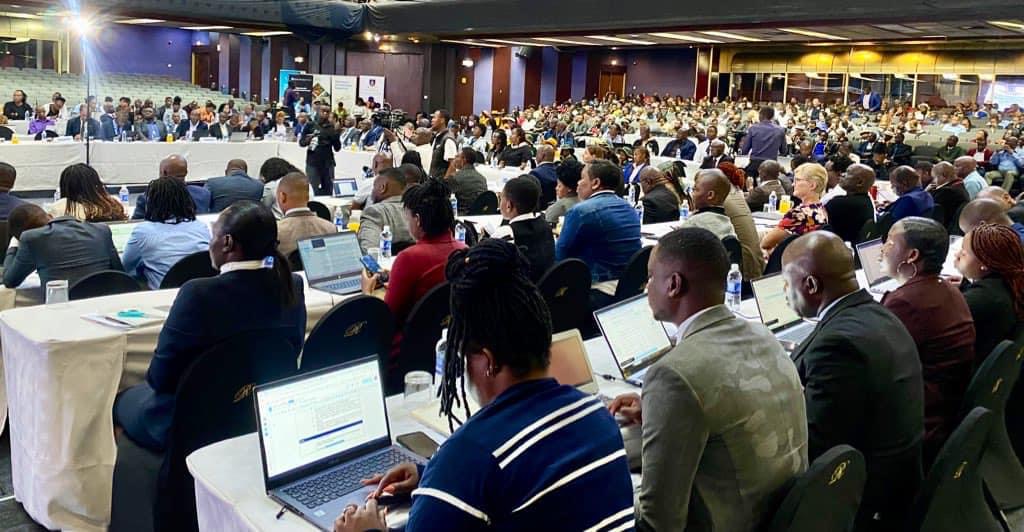
The second Climate Change and Development Conference opened yesterday in Harare, with a call to action to address the pressing climate challenges facing Zimbabwe.

Advertisement

The conference aims to cultivate collaborative dialogue and innovative solutions to build resilience and secure a sustainable future.

“The time for action is now,” said Edward Kallon, UN Resident and Humanitarian Coordinator, in his remarks at the conference.


Advertisement

“We must mobilize resources and strategic planning to align national efforts with global climate initiatives.”

The conference launched several strategic documents, including the Zimbabwe National Climate Change Adaptation Plan, the Green Resilient Recovery Strategy and Investment Plan, and the Long-Term Low Emission Development Strategy Investment Framework. These initiatives aim to guide comprehensive national strategies that respond effectively to the realities of climate change.

The conference today will cover diverse themes, including the impacts of climate change on health, gender-responsive climate action, and the integration of climate technology and finance to drive sustainable development.

Advertisement

Workshops and expert panels will facilitate knowledge sharing and collaboration among various stakeholders, including academia, government, civil society, and the private sector.

A key focus of the conference is the role of children and youth in climate action. “We must prioritize the voices of children and women as we develop climate policies,” said Kallon. “Their perspectives are crucial for creating effective solutions that will shape a sustainable future.”

The conference aims to empower stakeholders at community and national levels to create a resilient and sustainable future for Zimbabwe.

Advertisement

By fostering proactive collaboration and a shared commitment, participants will address the serious effects of climate change while safeguarding the well-being of both present and future generations.

The conference runs until this evening , and is expected to finalize its key results and recommendations for action in the fight against climate change.

Advertisement
Continue Reading
Click to comment

Leave a Reply

Your email address will not be published. Required fields are marked *

Slider

Inside South Africa’s lion breeding debate: A field visit to Mabula Pro Safaris

Published

on

BY NOKUTHABA DLAMINI

At the heart of Bela-Bela’s Driepdrift area lies Mabula Pro Safaris — a private predator breeding facility that, to many outsiders, represents one of the most controversial aspects of South Africa’s wildlife industry. But for the Zimbabwe Parks and Wildlife Management Authority (ZimParks) delegation, which recently toured the facility together with myself as a journalist from Zimbabwe, the visit provided an unusual opportunity: to see the behind-the-scenes reality of a commercial hunting lion breeding operation, far from the images often circulated in global media.

Advertisement

Led by Stephen Palos, Vice-Chair of the Sustainable Use Coalition Southern Africa (SUCo-SA) and CEO of the Confederation of Hunters Associations of South Africa (CHASA), the tour included a close look at lions bred under the South African Predator Association (SAPA) standards.

Inside the sanctuary, the group viewed 52 lions — including 12 adult males and 11 cubs — living in structured social groups within medium-sized enclosures. The animals walked freely, with access to shade, water, and open space.

An earlier visit to a predator sanctuary was, as pointed out by Palos, a stark contrast. Those were used to people whereas these would eat you in a heartbeat.

Advertisement

“These are breeding animals specifically, not pets,” he emphasized. “This is a breeding unit with the express purpose of producing lions for hunting. What you’re seeing here is very different from the popular ‘puppy farm’ narrative.”

Debunking the ‘puppy farm’ image

For years, global campaigns have depicted South African lion breeding as cruel and exploitative — with constant forced pregnancies, cubs immediately snatched from mothers, and animals confined in cramped cages. Palos argued that the facility before the delegation told a different story.

Advertisement

“Each enclosure functions as a pride,” he explained. “A male, a few females, different ages of cubs — just like in the wild, but within an enclosure. Look at the cleanliness, the condition of the animals, their behaviours. These animals are at ease.”

He stressed that cubs were not routinely separated from their mothers for tourism activities, and that animals destined for hunting were relocated to separate facilities to be raised with minimal human imprinting.

A fractured industry

Advertisement

Despite the orderliness observed at Mabula Pro, Palos admitted that the predator breeding industry suffers from fragmentation. Although SAPA prescribes standards for its members, adherence is voluntary.

“There are around 340 facilities in the country, but only about 43 are members of the association,” he said. “We cannot speak about those who choose to operate outside of these standards. That’s where the problems arise.”

What can African countries learn from each other?

Advertisement

After the tour, l asked what lessons Southern Africa can share across borders, including Zimbabwe.

Palos responded with a regional, long-term view.

“Every African country has something to teach and something to learn,” he said. “Wildlife is a renewable natural resource — but only if it’s managed properly.”

Advertisement

He contrasted South Africa’s fenced wildlife model with Zimbabwe’s largely open systems.

“South Africa relies heavily on fencing — from Kruger National Park to private ranches. But in Zimbabwe, Tanzania, Namibia, and elsewhere, you have vast open landscapes. Both systems work in their own contexts.”

Palos warned against “fortress conservation”, where communities are excluded from wildlife spaces — a model he says has failed people and wildlife alike.

Advertisement

Toward shared learning and mentorship

One of the strongest points he emphasized was the need for honest exchange between countries.

“It’s wonderful for us to learn from your challenges and successes,” he told the delegation. “But it’s even more important for us to show what works here, openly, and address our own challenges.”

Advertisement

He suggested that exchanges like this should evolve into:

Formal mentorship programmes
Boots-on-the-ground technical exchanges
Shared management experiments
Cross-border policy innovation

Economic lessons from a controversial industry

Palos acknowledged that South Africa has become a global leader in game farming and wildlife production systems — but insisted this does not invalidate the strengths of other countries’ models.

Advertisement

“There is economic success here,” he said. “But it’s not the only way. Zimbabwe already has strong systems. A blend of your models and ours could be even better.”

For the Zimbabwean delegation, the visit provided an opportunity to observe a facility that challenges both critics and defenders of the captive breeding industry. Whether South Africa continues down this path or phases it out — as many activists demand — facilities like Mabulapro Safaris remain central to the debate.

The tour served as a reminder that wildlife management in Africa is varied, complex, and always evolving — shaped by history, ecology, economics, and human needs.

Advertisement

Continue Reading

Slider

Southern Africa’s Sustainable Use Coalition slams CITES CoP20 decisions as “punishing success” and “killing with kindness”

Published

on

BY NOKUTHABA DLAMINI 

The Sustainable Use Coalition Southern Africa (SUCo-SA) has issued two strongly worded statements criticising decisions made at the CITES CoP20 conference in Uzbekistan, accusing Parties of undermining conservation success in southern Africa and ignoring evidence from range states.

Advertisement

In the first statement, SUCo-SA Vice Chair and the Confederation of Hunters Association of South Africa CEO Stephen Palos condemned the vote rejecting a proposal to remove the abundant southern giraffe from Appendix II. The proposal received 49 votes in favour, 48 against and 38 abstentions — including the 27-member EU bloc — falling short of the two-thirds majority required.

Palos called the outcome “yet another travesty of justice at the CITES CoP,” arguing that the decision reflects “a world dominated by an emotion before science philosophy in conservation.”

He singled out opposition from several African countries, saying:

Advertisement

“The most vocal objections made came from African countries with shocking records in conservation… where poaching, conflict, poverty, and desperation have decimated their wildlife, and now sell their souls to global anti-use/animal-rightist NGOs.”

Palos said the Chair “overlooked Eswatini and allowed none of the observer organisations an opportunity to speak,” forcing South Africa to call for a vote despite having “superbly presented” the proposal.

According to SUCo-SA, evidence showed that southern giraffe populations in Angola, Botswana, Eswatini, Malawi, Mozambique, South Africa, Zambia and Zimbabwe are “overwhelmingly increasing, with only one population reported as stable, and not a single population showing decline.”

Advertisement

The statement said this success is the result of “decades of effective national legislation, management frameworks, investment by private and community custodians, and sustainable-use incentives.”

But SUCo-SA argues that countries with no giraffe populations or poor conservation performance are influencing decisions that harm nations managing wildlife successfully.

“Once again, CITES (Convention on International Trade in Endangered Species of Wild Fauna and Flora) has managed to punish success and reward failure in conservation. And real people in southern Africa pay the price in hunger and deprivation.”

Advertisement

SUCo-SA: CITES Parties “killing with kindness” on rhino horn and ivory

In a second statement titled “CITES Parties Killing with Kindness at CoP20 – Rhino Horn & Ivory,” the SUCo-SA Executive criticised what it described as a predictable pattern where CITES Parties praise southern African conservation results while refusing to support related proposals.

The coalition said:

Advertisement

“They start by congratulating southern African range states for their ‘outstanding successes’… And then, without pause, they immediately announce that they will not support the proposal.”

The statement argued that many countries rejecting downlisting proposals come from regions where rhino or elephant populations have “collapsed or are entirely absent,” and that 47 years of trade bans and demand-reduction campaigns have failed.

“If 47 years of demand-reduction campaigns and trade bans have not saved rhino or elephants, at what point do we acknowledge that this approach is not working?” the coalition asked.

Advertisement

The statement questioned the positions of the EU, UK and USA, asking why they continue to “punish African conservation successes while rewarding failures” and why they “elevate the views of non-range states and discount the data, management systems, and lived realities of the countries that actually protect these species on the ground.”

According to SUCo-SA, southern African countries deserve practical support, not diplomatic praise that leads to policy obstruction.

“In the most diplomatic but patronising manner, southern African countries are told, in effect, to ‘go to hell, but enjoy the trip.’ This is what we mean when we say they are killing with kindness.”

Advertisement

The coalition said African states are “not asking for applause; they are asking for recognition of proven results” and the policy space to continue what works.

The statement concludes with a challenge to the global convention:

“CITES must decide whether it wants to remain a forum guided by evidence and sovereignty, or one led by political theatre and external pressure. The future of rhino and elephant conservation depends on that choice.”

Advertisement

Continue Reading

In the community

Hwange man sentenced to 40 years for raping two minors

Published

on

BY STAFF REPORTER

A 32-year-old man from Victoria Falls has been convicted by the Hwange Magistrates’ Court and sentenced to 40 years imprisonment  for raping two minors.

Advertisement

The man, whose name has been hidden to protect the image of the victims was being tried by the prosecutors on two counts of rape leading to the conviction.

The court heard that the accused committed the offences against two young female juveniles, aged nine 10 years old who are sisters on the 25th of September this year.

“The offender who was at his place of residence called the victims who were going to school to come to his place of residence to collect baobab fruits,” the National Prosecuting Authority said in a statement.

Advertisement

“They both got into the offender’s place of residence and the offender instructed the victims to get into his bedroom hut.

The victims complied and the offender followed them into his bedroom and closed the door from inside and raped them.”

The matter came to light on the same day when a relative informed the victim’s grandmother and father that she saw the victims leaving the offenders bedroom and they revealed what had transpired, leading yo his arrest.

Advertisement

Continue Reading

Trending

Copyright © 2022 VicFallsLive. All rights reserved, powered by Advantage