BY NYASHA CHINGONO
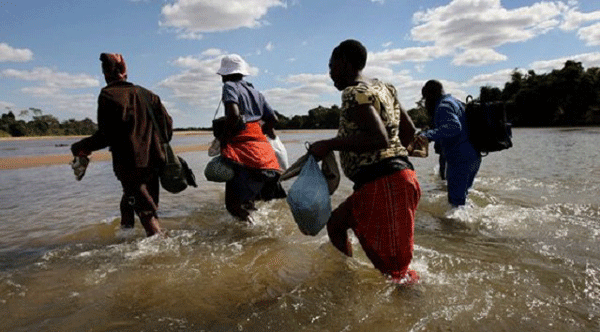
A bushy pathway leads to the crossing points along the Limpopo River that are the most treacherous part of the journey for Zimbabweans seeking a better life in South Africa.
The river has flooded after weeks of incessant rain, resulting in three drownings of “border jumpers” last month alone.
A few kilometres away, where the roar of the river can still be heard, men and women clutching small bags of belongings trudge along a different dusty track near Malindi Transit Shed.
At 9am on a Friday morning in February, the route to the bridge connecting South Africa and Zimbabwe is already heavily patrolled by soldiers clasping rifles.
The journey to Beitbridge on the Zimbabwean side is punctuated by five security checkpoints, with a bribe of 50 rand (£2.40) required by the soldiers and police at each stop.
“Where are you going? Come here!” shouts a soldier at a woman in a black tracksuit. After questioning her, he allows the woman to pass.
The path continues to the old Alfred Beit Bridge, where the road crosses the Limpopo between Musina in South Africa and Beitbridge in Zimbabwe. Here, border-jumping guides, known as magumaguma, are ready to assist in illegal crossings.
It is a steady stream, as Zimbabweans fleeing economic turmoil seek opportunities in South Africa, a more stable economy.
Rising inflation, unemployment and poverty drives most Zimbabweans to make the journey.
Those who can afford the bribes take the bridge. Others try their luck in the fast-flowing waters, where crocodiles swim.
The risks are high: about 100 Zimbabweans are deported daily, according to South Africa’s Department of Home Affairs.
But Zimbabweans with little left at home are still making the journey in their droves.
“You just pay 20 or 50 rand and they will let you pass. But at every stop, you have to part with something.
This is the price one pays to gain safe passage,” says Gain Murambiwa*, 38, a taxi driver.
Another driver says it is more expensive in South Africa, where security has been stepped up.
“Anyone serious about crossing should at least part with 600 rand, because it is more expensive in South Africa.
I normally do five or six trips because many people want to jump the border and we are here to help. There is brisk business when the border is closed like this,” he says.
Moud Mbedzi*, 39, is hoping to join her husband, who left for South Africa before the pandemic.
Holding a small bag of clothes, she says: “I have already communicated with someone on the other side who will help me get past security into South Africa.”
She has left her two children in the care of her mother. “Luckily, my husband found a job and if I get one also, we will get enough money to take care of our children. It’s sad to leave them but I have to go,” she says.
Another hopeful traveller is Bright Ntepe*, 30, an engineering graduate.
“There is nothing here for me. I have tried everything. Maybe there is a better life for me in South Africa. I know it is not going to be easy but I will try,” Ntepe says.
The high river levels are undoubtedly deterring some.
At Spillway, a once-popular illegal crossing about a mile from Beitbridge, the men fishing say the river is too dangerous to cross.
“We hardly see anyone coming to cross because the waters are too deep. It is very quiet these days,” says 30-year-old Arnold Muzemba*.
But at other spots the risky crossings continue. Farther along the river, a group of men are repairing a broken wooden boat at one of the few illegal crossing points still in use since the river started rising.
Moses Mbedzi*, 40, transports both people and goods across the river.
His raft is big enough to carry 12 people at a time, plus a refrigerator or other home appliances. Smugglers also pay large sums to move contraband across.
Driving home a nail as he tries to finish the work before the rain comes, he says three of his boats have been destroyed by the authorities in recent weeks, so he is making another one.
“This is the only job I know. How do I feed my family without helping people to cross? I know it is a dangerous job but I have to do it,” Mbedzi says.
“The day before yesterday, they [the security forces] destroyed my raft, but luckily they left the rope that we use to control the raft so that it is not swept away by the current.
“This is a dangerous undertaking, but I cannot sit at home and do nothing.”
The Limpopo runs for about 160 miles (260km) along the border, and the police have just eight bases, 20 miles apart, making it difficult to control.
“These people are adamant. We always take their boats but you will see them the next day with a new one.
They even tried to create a wooden bridge years ago but it was destroyed by our South African counterparts,” a Zimbabwean soldier says.
Zimbabweans who succeed in breaching the border still have to get past dozens of roadblocks on the other side.
According to South Africa’s home affairs minister, Aaron Motsoaledi 13 387 people were arrested at roadblocks between 10 December and 31 December last year for border jumping and smuggling-related offences.
The pandemic has exacerbated smuggling between the two countries, with the South African Police Service (SAPS) saying smuggled goods include cigarettes, explosives and stolen vehicles.
“The South African Police Service is working together with other stakeholders in the Justice, Crime Prevention and Security cluster at the borders as well as on the border line to curb illegal crossings of persons and the smuggling of items,” says its spokesperson, Col Athlenda Mathe.
“On a weekly basis, there are undocumented persons who are mostly job-seekers that are apprehended by the SAPS and handed over to Zimbabwean authorities through a repatriation process which is dealt with by the Department of Home Affairs,” says Mathe.
But even as the authorities in both countries try to stem the flow across the border, the economic crisis in Zimbabwe shows no sign of easing and the number of people prepared to risk the crossing for a better life is only rising. – The Guardian
* Names have been changed to protect their identity










 Slider3 years ago
 National5 years ago
 Tourism and Environment4 years ago
 Special reports4 years ago
 Opinion4 years ago
 National4 years ago
 National3 years ago
 National3 years ago