BY NOKUTHABA DLAMINI
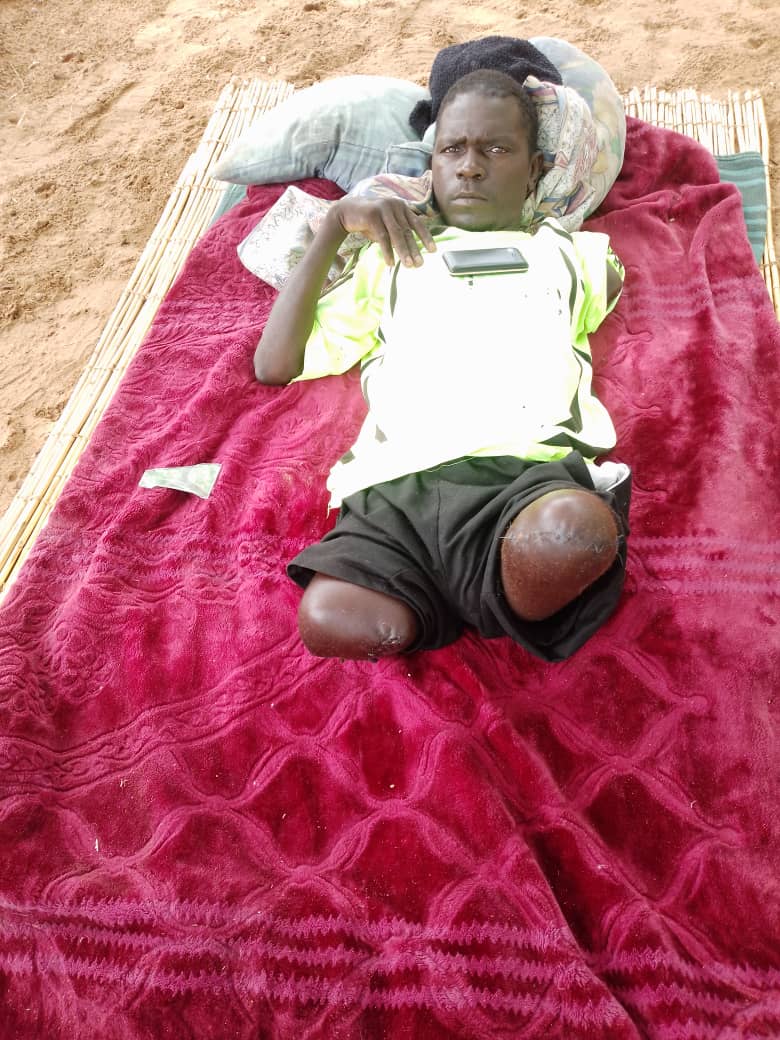
A Binga man, who survived a vicious attack by a crocodile after jumping into Mlibizi River while running away from a herd of elephants almost three months ago, is struggling to survive after both his legs and left arm were amputated.
Windas Sianene Muleya (43) jumped into the jaws of the giant reptile while running away from a herd of five elephants that was encircling him during a fishing expedition.
Muleya, a father of three from the Chief Saba area, survived the attack by jumping on the back of the crocodile and shoving his arm down its throat to make it gag until rescue arrived.
His legs and arm were first amputated at Mpilo Central Hospital in Bulawayo before another amputation on both legs in neighbouring Zambia after doctors there said the initial procedures were botched.
Muleya , an unemployed widower, is now unable to fend for himself and his children and is also saddled with huge hospital bills.
“I have had to move back from my homestead to live with my mother together with my children, who are still very young,” he told The Standard .
“There was a wheelchair that was donated to me, but I cannot push it because of the dust and oftentimes when it starts to rain and there is no one close to assist me, I get rained on.
“I have soiled myself several times because it gets too overwhelming for my family, especially for my mother (to take care of me).
“I need medical assistance, a bedroom that is ideal for my condition and a toilet close to my room because I struggle to go and relieve myself in the bush.”
His cousin Tendayi Zulu Sianene said the family had incurred a lot of costs while seeking treatment for Sianene, both in Zimbabwe and Zambia.
“We still have a bill to pay at Mpilo Hospital because the admission was free, but surgery cost $291 000 and we have only managed to pay $50 000,”Tendayi said.
“In Zambia we paid 3 000 Kwacha to cover the first three days and thereafter for the other 15 days we were paying 500 kwacha per day inclusive of everything.”
Muleya said the government was yet to give him any assistance despite some officials showing an interest in his case when his story first hit the headlines.
“I have not been helped by anyone from the government,” he said.
“They tried to contact me soon after the incident, but I have not heard anything from them since then.
“It’s only well-wishers that have been assisting me.”
Sianene narrated for the first time how the September 28 incident that altered his life forever unfolded.
He said he was fishing close to his homestead on the confluence of Mlibizi and Zambezi rivers when he suddenly saw a herd of five elephants charging towards him.
There was nowhere to run to for the fisherman as he was on an island and the elephants were charging from the only route out of the area.
“I jumped into the river to try and hide under the water close to the river bank, but I landed on a lurking crocodile that immediately attacked me,” Sianene said.
“Some fishermen that were close by jumped into the river to fight the crocodile and that’s all I remember as I immediately lost consciousness.”
He was rushed to Binga District Hospital and he says his relatives used cardboard boxes to cover bones that were protruding from his arm and legs.
Sianene was immediately transferred to Mpilo Central Hospital in Bulawayo, which is about 436 kilometres from his home and he arrived at night.
The following morning a decision was made to amputate his left leg and left arm.
“After the amputation they stitched my right leg in many areas. The leg was not broken, but it was injured from below the knee and it was bandaged after the stiching,” he said.
“The following day that leg was painful and swollen. I alerted the nurses, but no action was taken.
“I spent the whole Saturday pleading for help because the bandage was too tight and I was in pain.
“A decision was taken on Sunday morning to check why the right leg was swollen and they found out that there was puss.
“The bones were now exposed again after the stitches had burst and they told me that they were going to amputate it as well as there had been a severe infection, which explained the puss.”
His right leg was amputated just below the knee. Sianene was discharged from hospital, but the pain did not go away until his family decided to take him to neighbouring Zambia for treatment.
A doctor at Livingstone Hospital informed them that the amputation was not properly done as the legs were not aligned.
The Mpilo Hospital doctors had amputated Sianene’s right leg from below the knee while the left leg was amputated close to the hip and the Zambian doctor said that would affect his balance.
“On the left arm he also noted that there were some bones that were still exposed and that was the same case as the left leg.
“A decision to redo the surgery was then made,” he recounted.
“A few days later I was asked to sign another letter so that I could go to the theatre and that was the fourth time I was being amputated.
“This time it was to align the right leg with the left one.
“The doctors had noted that the wound was not going to heal as it was amputated close to a muscle rapture and the bones were exposed too.”
Sianene spent 17 days at Livingstone Hospital.
When he returned home he ran out of medication and missed his review date at Binga Hospital by two days because there was no transport.
“When we eventually got to the hospital there was no doctor and the nurses told me that the hospital had run for some time without electricity and as such they could not check why my right leg was still swollen and was not healing,” he added.
“They resolved to admit me to monitor my condition, but I failed to pay the US$6 per night that government hospitals charge.
“I had to travel back home and I am still in pain because both my thighs often swell.”
Sianene is one of the many victims of human wildlife conflict in Zimbabwe that struggle to get treatment for their injuries or to get compensation for loss of livelihoods.
The government recently announced that it was creating a fund for victims of human wildlife conflict that would cover medical expenses and hospitalisation, among other things, but critics say it is not clear where the money would come from.




 Slider3 years ago
 National5 years ago
 Tourism and Environment4 years ago
 Special reports4 years ago
 Opinion4 years ago
 National4 years ago
 National3 years ago
 National3 years ago