Connect with us

In the community

Covid-19 vaccines give battered Victoria Falls new hope

Published

on

BY FARAI MUTSAKA

Victoria Falls usually teems with tourists who come to marvel at the roaring Zambezi River as it tumbles down more than 108 meters to the gorge below, sending up a mist that is visible from miles away.

Advertisement

“The Smoke That Thunders” – the English translation of what the waterfall is called in the Sotho language – is still mighty, but the Covid-19 pandemic has reduced visitors to a trickle.

Ordinarily, Victoria Falls attracts 350,000 tourists a year, but their numbers have dropped to almost none as a result of travel restrictions.

Hotel occupancy rates fell into the single digits during 2020 and the first half of 2021, and some hotels were forced to close, according to the Hospitality Association of Zimbabwe.

Advertisement

To promote Victoria Falls as a safe destination, President Emmerson Mnangagwa’s government has made vaccines available to all 35,000 residents of the town that shares a name with the waterfall.

An estimated 60% of the people there have been vaccinated with either the Sinopharm or Sinovac vaccines, both from China.

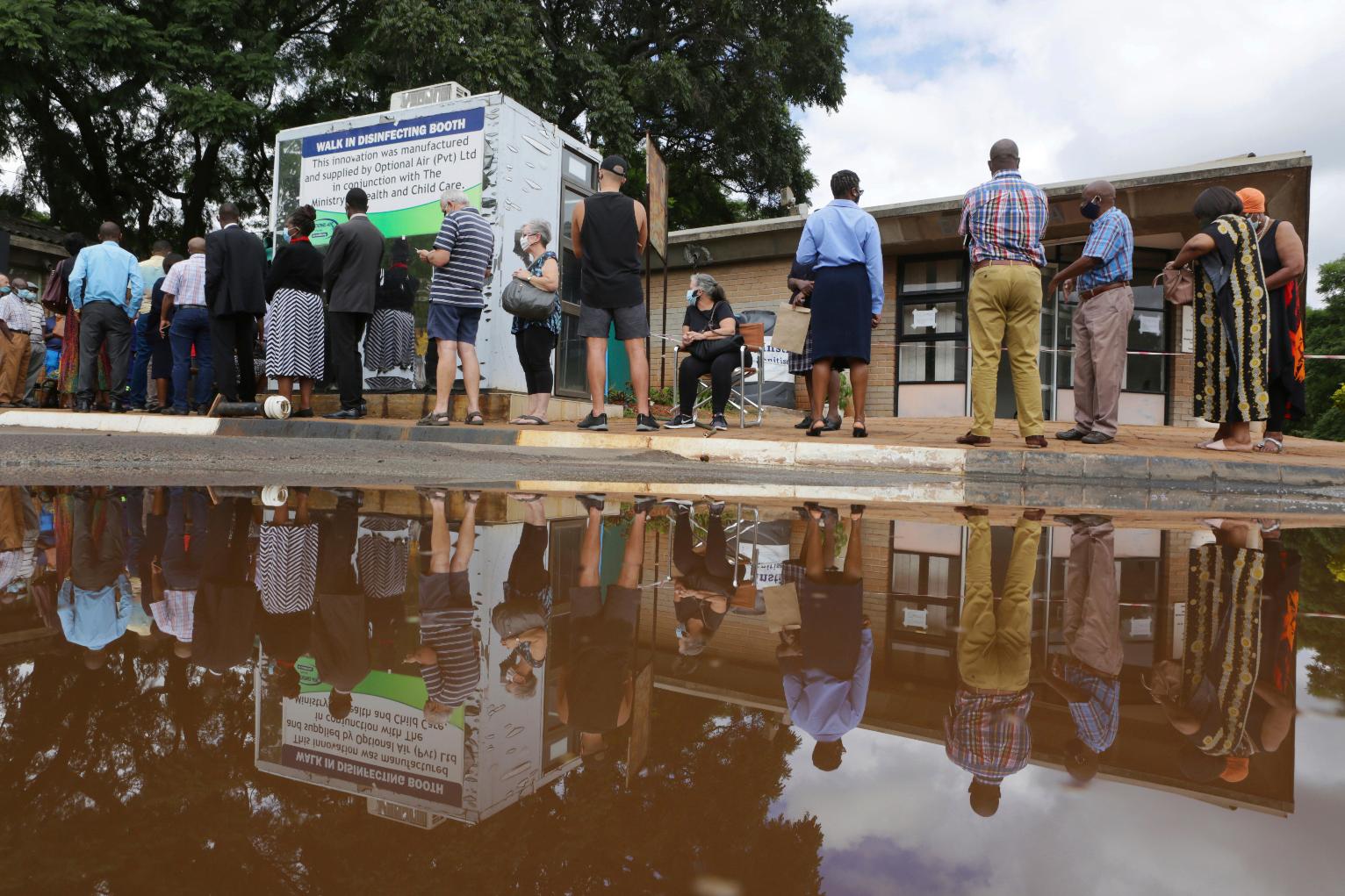
Although tourists have not returned in large numbers, Victoria Falls mostly has been spared the current wave of Covid-19 that has swept across the rest of Zimbabwe and southern Africa, which health officials attribute to the town’s relatively high level of vaccinations.

Advertisement

Nationwide, over 1.8 million people, slightly more than 12% of Zimbabwe’s population, have received a first dose, while more than 900,000 people are fully vaccinated with two doses.

On the strength of the vaccination rate in Victoria Falls, the government recently reopened two land borders that link the town to the neighboring countries of Zambia, Namibia and Botswana.

Travelers with proof of vaccination and a negative Covid-19 test will be permitted entry.

Advertisement

Victoria Falls was where Zimbabwe recorded its first Covid-19 case in March 2020, likely because of its high number of international visitors.

A year later, at a time where only medical workers and other essential workers were eligible for vaccines, shots were made available for all of the town’s residents age 18 and older.

All adult Zimbabweans are now eligible, but because of widespread supply shortages, the lines for jabs are long and many people are disappointed.

Advertisement

Restaurants in Victoria Falls are allowed to serve sit-in customers – something that is forbidden in the rest of Zimbabwe, which still has tight restrictions as a result of the current surge driven by the delta variant of the coronavirus.

Close to 90 percent of Covid-19 hospitalisations and deaths in the current surge are of unvaccinated people, according to a recent report by the Ministry of Health.

Although planeloads of tourists have not yet returned, the reopening of Victoria Falls was a relief for a town that survives on tourism, Anald Musonza, the regional chairman of the Hospitality Association of Zimbabwe, told The Associated Press.

Advertisement

“We had been waiting for this for a long time,” Musonza said. “This will help us retain some jobs that were lost due to the pandemic.”

Tourism, together with mining and agriculture, is a key anchor of Zimbabwe’s fragile economy.

Mass vaccinations could help open up tourist destinations countrywide, said Tinashe Farawo, a spokesperson for the Zimbabwe National Parks and Wildlife Management Authority.

Advertisement

The loss of tourism revenue has hurt the authority’s ability to operate.

“Victoria Falls is testimony of what vaccines can do,” he said. “It’s good for us.

“It’s good for wildlife because now we can raise money to deploy our rangers and fund other critical operations.” – AP

Advertisement

Continue Reading
Click to comment

Leave a Reply

Your email address will not be published. Required fields are marked *

Hwange

Hwange Central finally receives long-awaited CDF funds

Published

on

BY NOKUTHABA DLAMINI

Hwange Central constituency has finally received its long-awaited Constituency Development Fund (CDF) allocation, marking the first disbursement since 2022, Member of Parliament for the area, Fortune Daniel Molokele, has confirmed.

In a statement, Molokele said an amount of ZiG 1.3 million was deposited last week into a special bank account set up exclusively to administer CDF funds for the constituency. The disbursement falls under the 2024 national budget, following confirmation from the Parliament of Zimbabwe that no CDF disbursement will be made under the 2023 national budget.

He further noted that there is still no clarity on when CDF allocations under the 2025 and 2026 national budgets will be released.

“With this development, our local CDF Committee will, during the coming week, initiate the process of rolling out the approved projects,” said Molokele.

Priority Wards and Projects

The initial phase of implementation will cover five wards, namely Wards 1, 4, 5, 6 and 14, with the remaining wards expected to benefit under the next CDF disbursement.

According to minutes from a public consultation meeting held on 13 April 2024 at St Ignatius Primary School in Hwange, the community unanimously prioritised solar-powered boreholes with JoJo tanks and fenced nutritional gardens as the flagship project for the 2024 CDF cycle.

The project is set to be implemented at the following locations:

  • Ward 1: Chibondo
  • Ward 4: Baghdad
  • Ward 5: Empumalanga
  • Ward 6: Phase Four
  • Ward 14: Ngumija

Other proposals discussed at the meeting included the construction of an Advanced Level laboratory science facility at Nechilisa Secondary School and the refurbishment of Nengasha Stadium, but these were deferred in favour of addressing water and food security.

CDF Committee in Place

The public meeting also elected a new 2023–2028 CDF Committee, comprising:

  • Alice Phiri (Trade Unions, Women and Local Communities)
  • Luka Katako (Traditional Leaders and Faith-Based Leaders)
  • Bryan Nyoni (Youth and Local Communities)
  • Shonipai Muleya (Finance and Accounting)

Francisca Ncube was nominated as the National Assembly representative, while Teresa Kabondo will represent the constituency in the Senate.

The CDF bank account signatories and procurement committee members include Molokele, Luka Katako, Thulani Moyo and Alice Phiri.

Funding Clarifications

Although earlier discussions indicated that the 2024 allocation would include outstanding funds from 2023—bringing the total to an estimated USD100 000, to be disbursed in ZiG at the interbank rate—the Speaker of Parliament later clarified that the 2023 CDF allocation was no longer available.

“As a result, each constituency ended up receiving ZiG 1.3 million, which was meant to be equivalent to USD50 000,” Molokele explained, adding that the approved projects were subsequently endorsed by the relevant Parliamentary committee.

He also confirmed that no CDF proposals have yet been submitted for 2025 and 2026.

Residents seeking further information have been advised to contact CDF Committee Secretary Thulani Moyo on 078 648 3659.

Molokele said at least two public feedback meetings will be held once implementation begins, to ensure transparency and accountability in the use of the funds.

Continue Reading

In the community

Two artisanal miners die in Umguza mine shaft collapse

Published

on

BY STAFF REPORTER 

Two artisanal miners have died following the collapse of a flooded mine shaft at Cement Side in Umguza District, ZBC has reported.

The incident occurred early Tuesday morning after heavy water ingress caused the shaft to give way, trapping the two men underground.

When rescue teams arrived at the scene, officers from the Bulawayo Fire and Ambulance Services Department, assisted by local volunteers, were leading recovery efforts.

A survivor of the incident, Khulumani Nkomo, described the terrifying moments leading up to the collapse.

“We heard a loud cracking sound as we reached the ground, then water started rushing in. The two were behind us, and the shaft just closed, trapping the other one in the tunnel,” he said.

Nkomo added that attempts to rescue the trapped miners proved futile.

“We tried to dig with our hands and tools, but the water kept coming. By the time help arrived, it was already too late.”

A brother of one of the deceased miners said the family is struggling to cope with the loss, revealing that the victim was only 19 years old.

Continue Reading

In the community

Foot and mouth disease outbreak in Mat North

Published

on

BY NIZBERT MOYO

The provincial Veterinary Department has urged farmers to comply with livestock movement regulations following an outbreak of the Foot and Mouth Disease (FMD) in some parts of Matabeleland North.

Acting provincial veterinarian Gwinyai Zhandire confirmed the outbreak to Southern Eye, saying the government has instituted movement controls, vaccination and active surveillance in the affected areas.

“There are some dip tanks affected in the Nyamandlovu area,” Zhandire said.

“The government has instituted movement controls and vaccination, and we are conducting surveillance.

“Farmers are encouraged to observe and comply with livestock movement regulations to prevent further spread.”

He highlighted that the rainy season increases the risk of other livestock diseases.

With tick populations on the rise, farmers should be vigilant against tick-borne illnesses such as Anaplasmosis (Gall Sickness), Theileriosis (January Disease), Ehrlichiosis (Heartwater) and Babesiosis (Redwater).

“Weekly dipping is encouraged to prevent transmission between animals,” Zhandire said.

He emphasised the importance of routine vaccination against other seasonal threats, including anthrax and lumpy skin diseases.

The outbreak has also affected farmers in the Umguza area, who have similarly been directed to adhere to animal movement restrictions.

Foot and mouth disease is a highly contagious viral disease that affects cloven-hoofed animals, including cattle, sheep and goats.

The disease is characterised by fever and the development of painful sores or blisters in the mouth and on the feet, often leading to severe lameness and a drop in productivity.

The virus spreads easily through direct contact between animals, as well as via contaminated equipment, vehicles and feed.

The disease can result in significant economic losses in the livestock industry due to trade restrictions and animal health costs.
Source: Southern Eye


Continue Reading

Trending

Copyright © 2022 VicFallsLive. All rights reserved, powered by Advantage