Connect with us

National

Another Zimbabwe gold coin sale registers little for most

Published

on

BY GAMUCHIRAI MASIYIWA

With the price of gold up globally, the Reserve Bank of

Advertisement

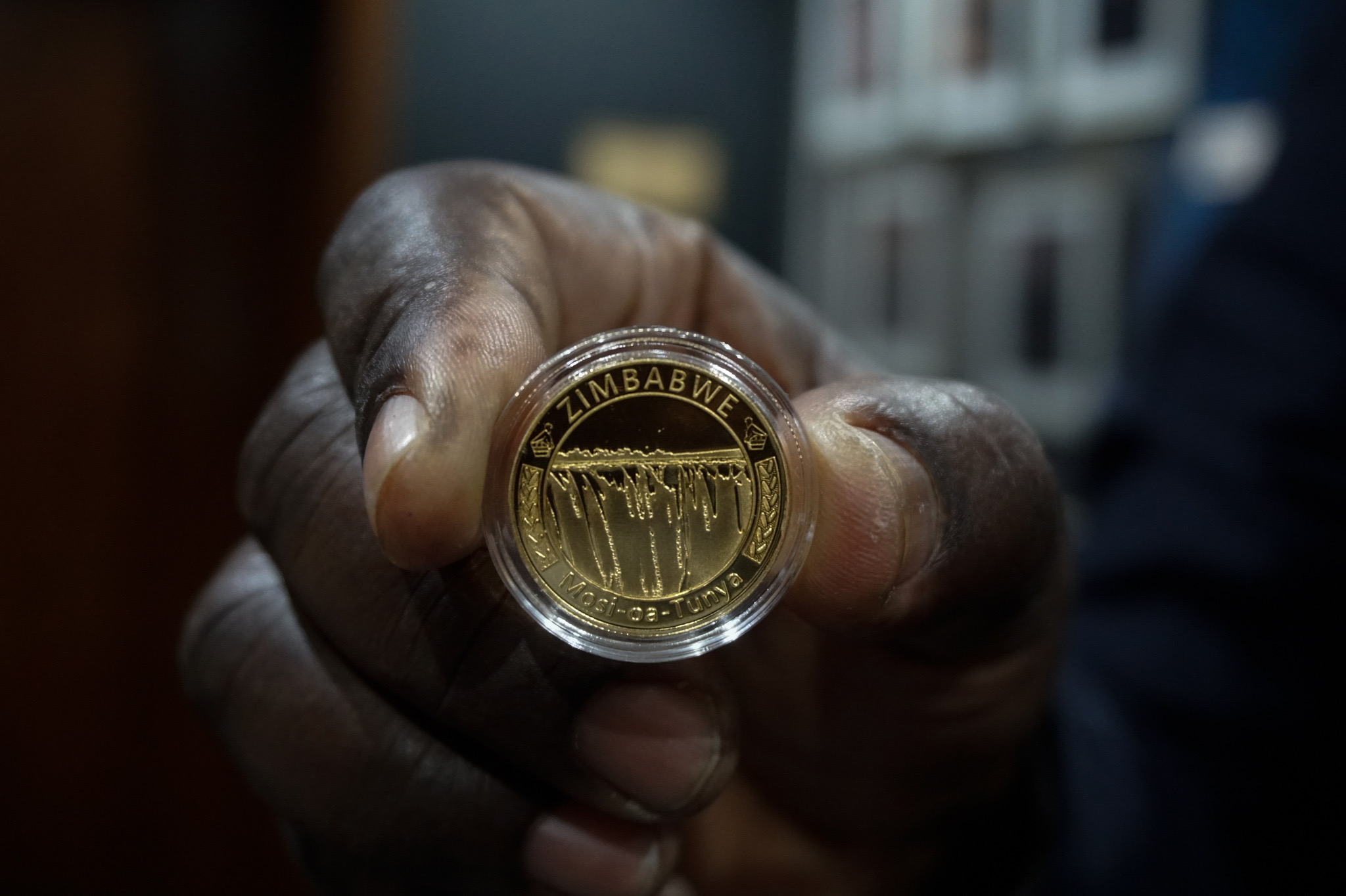
Zimbabwe in April put the gold coins it stopped minting a year earlier back on the

market.

But interested investors had to act fast.

Advertisement

By mid-June, the sale of coins from its accumulated stock was abruptly concluded

and another chapter of the currency chaos that has characterized the nation’s

economy for decades was in the books. This time, at least, economists say the

Advertisement

experiment had little effect.

The short-lived sale is just the latest example in a long line of inconsistent policies,

says Ithiel Mavesere, a lecturer in the economics and development department at theUniversity of Zimbabwe. Storing value in a gold coin is not a viable option for the

Advertisement

majority of the population, he adds.

“Ideally, what they should have done is come up with low-value coins, with

denominations as low as equivalent to US$20 for the majority of the population to

Advertisement

afford,

” Mavesere says.

However, Reserve Bank of Zimbabwe Governor John Mushayavanhu says in a written

Advertisement

response to Global Press Journal that the gold coins were effective as an alternative

investment instrument and there was huge demand from both corporations and

individuals. According to RBZ data, corporations bought about 79% of the gold coins

Advertisement

and individuals bought about 21%.

About US$12 million’s worth sold

The lowest denomination of the coins represents a tenth of an ounce of gold,

Advertisement

equivalent to 9,299.13 in Zimbabwe gold, or ZiG, the national currency, or about

US$347. The highest denomination of the coins represents one ounce of gold,

equivalent to ZiG 92,991.34 or about US$3,470.

Advertisement

In all, the central bank has sold gold coins worth ZiG 343 million, or about US$12.8

million, according to Mushayavanhu, who says the recent sale happened after the

bank noted increased demand following the rise in international gold prices.

Advertisement

“In this context, the Reserve Bank re-issued an accumulated parcel of gold coins from

a combination of gold coins which had been bought back from the market through

redemptions and some coins which were still being held at the Reserve Bank from

Advertisement

the previously minted stock,

” the governor wrote.

A statement from the bank in mid-June announcing the halt to the sale indicated it

Advertisement

had been intended to clear the stock of gold coins it had and those that had been

cashed in by their holders.

Mushayavanhu says the bank stopped minting gold coins in April 2024 to prioritize its

Advertisement

gold reserve which, along with foreign currency reserves, backs the Zimbabwe gold

currency.

He says foreign reserves increased from US$270 million in April 2024 to US$731 million

Advertisement

as of the end of June.

The central bank first introduced the Mosi-oa-Tunya gold coins — which share an

indigenous name for Victoria Falls — in 2022 at a time when the country was

Advertisement

experiencing currency instability with high inflation and continued devaluation of

what was then the national currency, the Zimbabwe dollar.

The coins aimed to reduce dependency on the US dollar and help stabilize the

Advertisement

economy. The coins helped mop up excess cash in local currency that was circulatingin the market. Coupled with other monetary measures in 2022, the monthly inflation

rate dropped from about 31% in June to about 12% in August that year.

However, the exchange rate of the Zimbabwe dollar drastically fell against the US

Advertisement

dollar and the government replaced it with the new Zimbabwe gold currency in April

2024. Since its introduction, the currency’s value has been cut in half.

A ‘drop in the ocean’

Advertisement

Lyle Begbie, an economist with Oxford Economics Africa, believes the sale of the gold

coins when they were introduced in 2022 was more of a revenue-generating scheme,

as it happened at a time when inflation was very high.

Advertisement

He says it makes sense that the recent sale of gold coins was influenced by the

increase in gold prices on the global market. But he adds that the value of gold coins

was too little to have an impact on the economy. Begbie says the US$12.8 million in

Advertisement

coins the central bank reported selling is less than 1% of Zimbabwe’s gross domestic

product — which the World Bank estimates at US$44 billion — a “drop in the ocean”

when it comes to the country’s macroeconomic picture.

Advertisement

Prosper Chitambara, an economist based in Harare, agrees the impact of the recent

sale was minimal. He says gold coins don’t have a significant impact on currency

stability in an economy like Zimbabwe’s, which is highly informal and also highly

Advertisement

dollarized — meaning it’s heavily reliant on the US dollar as a currency.

“Most economic agents in our economy prefer to transact using their US dollars

because it’s a highly tradable and highly liquid asset. … So there’s a huge confidence

Advertisement

and trust in the USD than in the gold coins or even in the Zimbabwe gold,

Chitambara says.

Advertisement

Samuel Wadzai, the executive director of Vendors Initiative for Social and Economic

Transformation, an organization in Harare that advocates for the informal business

sector, says there have been a few instances where members have tried to use gold

Advertisement

coins for everyday transactions, but it hasn’t been widespread.

“Most traders still prefer cash due to the challenges of acceptance and the limited

understanding of gold coins in everyday trade,

Advertisement

” he says.

Isheanesu Kwenda, 31, a Harare street vendor with a sociology degree, says the recent

sale of gold coins didn’t offer any benefit for him. Like many Zimbabweans, he has

Advertisement

heard about the gold coins, but has never seen or opted to buy them. The vendor is

part of Zimbabwe’s informal economy, which sustains over 80% of Zimbabwe’s

population and contributes nearly 72% to the country’s GDP.

Advertisement

“Street economics informs that you should not attempt to get something you are not

sure of or do not understand. … I prefer to sell my goods and keep my money in US

dollars because it holds value, or I can keep my money in stock,

Advertisement

” Kwenda says of theclothing he sells.

Last year, Kwenda lost more than half his earnings after Zimbabwe gold was

introduced. After being paid the equivalent of US$1,000 in Zimbabwe dollars, he only

Advertisement

managed to salvage US$360 and lost the rest in exchange rate losses.

For Kwenda, restoring confidence is simple: The government must stick to a plan,

without making sudden U-turns

Advertisement

This story was originally published by Global Press Journal

Advertisement
Continue Reading
Click to comment

Leave a Reply

Your email address will not be published. Required fields are marked *

National

Government launches nationwide dog vaccination drive amid surge in rabies cases

Published

on

BY WANDILE TSHUMA 

The Government has launched an urgent nationwide dog vaccination campaign following a surge in rabies cases across Zimbabwe.

Advertisement

In a statement posted over the weekend, the Ministry of Lands, Agriculture, Fisheries, Water and Rural Development said the country is experiencing a significant rise in rabies infections, largely linked to domestic dogs and wild jackals.

Permanent Secretary Prof. Obert Jiri confirmed that 650,000 doses of rabies vaccine have been secured from Botswana — exceeding the country’s usual annual requirement — to contain the escalating threat.

The Ministry said the campaign will be rolled out in the coming weeks across all provinces, targeting hotspots near national parks and conservancies, as well as urban areas that have recorded increasing cases.

Advertisement

Prof. Jiri stressed the urgency of seeking immediate medical attention following dog bites, warning that rabies is fatal in humans once symptoms appear.

He appealed to dog owners to ensure their pets are vaccinated, saying collective action remains the primary defence against the deadly disease and is critical in preventing further fatalities.

Advertisement
Continue Reading

National

Matabeleland North flags aid discrimination as provinces record widespread violations

Published

on

BY NOKUTHABA DLAMINI 

Matabeleland North recorded cases of discrimination in government aid distribution and political interference in community leadership, as human rights violations were reported across all provinces in January, according to the Zimbabwe Peace Project (ZPP).

Advertisement

In Matabeleland North, five violations were documented.

“On 9 January 2026, in Ward 29 (Emphafeni), farmers reported irregularities in agricultural input distribution, including selective allocation of groundnuts and maize seed to ruling party supporters, and sharing of 50kg fertiliser bags among three farmers, raising concerns over fairness and equal access to government assistance,” the report states.

In Binga South, a village secretary was removed from his position “for not aligning with ruling party positions, affecting his political rights and freedom of association.”

Advertisement

In Matabeleland South, four violations were recorded, mainly involving political intimidation. In Gwanda, individuals allegedly invaded Vubachikwe Mine claiming political backing, while in Bulilima West, villagers were reportedly threatened with losing land under the land reform programme if they did not support the “2030” agenda.

Bulawayo recorded two violations, including a case where “a visually impaired woman was denied bus transport from Bulawayo to South Africa despite having valid travel documents and fare, raising concerns of discrimination based on disability.” Residents in Old Magwegwe also reported prolonged sewage blockages exposing families to health risks.

Midlands province recorded 13 violations, including environmental concerns in Redcliff and Kwekwe over potential water contamination linked to gold processing chemicals. In Zhombe, political interference prevented enforcement of a court sentence in an assault case. In Silobela, police disrupted a Gukurahundi memorial service organised by a human rights group.

Advertisement

Masvingo recorded 19 violations, including the assault and arrest of a female vendor at SimRac Shopping Complex. The report says her goods were destroyed in what it describes as harassment of informal traders. Patients at Mashoko Hospital and Gawa Clinic also faced high user fees and limited medication.

Mashonaland West recorded 10 violations, including alleged irregularities in agricultural input distribution in Magunje and assault linked to ruling party supporters in Sanyati.

Mashonaland East documented six violations. In Murehwa North, “Provincial Chairperson and Minister Daniel Garwe threatened individuals in Ward 30, warning that those supporting the opposition CCC would be excluded from community programs and that anyone associating with CCC members could face violent reprisals.”

Advertisement

Mashonaland Central recorded four violations, including exclusion of community members, including persons with disabilities, from presidential agricultural inputs in Mt Darwin South, and learners being denied access to Grade 7 results over unpaid fees.

Harare recorded 16 violations, including assaults linked to political intolerance, disruption of civic gatherings, politicisation of borehole water access in Glenview, and the detention of a political activist over a planned protest.

Manicaland recorded the highest number of violations at 31. ZPP said incidents involved “state security agents, ruling party members, war veterans, and local authorities,” including intimidation of a human rights defender in Chimanimani and disruption of a community meeting in Nyanga South.

Advertisement

Overall, ZPP said the January data reflects “continued structural and institutional challenges in the protection, promotion, and fulfilment of human rights,” reinforcing the need for strengthened accountability and rights-based governance across the country.

Advertisement
Continue Reading

National

Police arrest six in major drug busts across the country

Published

on

BY BANDILE TSHUMA

The Zimbabwe Republic Police (ZRP) has arrested six suspects in separate incidents involving the unlawful possession and cultivation of dangerous drugs across the country.

Advertisement

In a press statement written on Monday, police said the arrests were part of ongoing efforts to curb drug trafficking and substance abuse.

On Sunday , police in Plumtree intercepted a Toyota Quantum vehicle and arrested Msawenkosi Ndlovu (49) and Vengai Chawa (41). The two were found in possession of 5 124 bottles of Broncleer cough syrup (100ml) and 4 170 bottles of Astra Pain cough syrup (100ml). The illicit substances are valued at approximately US$80 000.

In a separate case on the same day, police in Wedza arrested Emanuel Busemani (28) at Plot 7 Investment Farm in Melfort, Goromonzi in connection with the unlawful cultivation of dagga.

Advertisement

Meanwhile, in Bubi, Lacken Tshuma (55) and Owner Muleya (32) were arrested on Monday at Inunwa Ranch for unlawful cultivation of dagga.

In another incident on Friday, Tinashe Mero Shoko (22) and Eliot Badza (33) were arrested at a house in Garikai, Dulibadzimu, Beitbridge after police recovered 100 kilogrammes of dagga.

Police reiterated that the fight against drug and illicit substance peddling and trafficking will continue for the safety and security of Zimbabweans.

Advertisement

The ZRP urged members of the public to provide information on drug lords, dealers and criminal syndicates. Reports can be made through the National Complaints Desk on (0242) 703 631, via WhatsApp on 0712 800 197, or at any nearest police station.

Advertisement
Continue Reading

Trending

Copyright © 2022 VicFallsLive. All rights reserved, powered by Advantage