
National
‘Fury over Chinese coal mines, Covid-19 herd immunity, deadly underground fires’: The Matabeleland North stories that trended in 2021

BY VICFALLSLIVE
From attempts by Chinese coal miners to set up mines deep into the Hwange National Park, underground coal fires that claimed the life of a Hwange girl to the ambitious programme by government to reopen the tourism industry by vaccinating all eligible people in Victoria Falls against Covid-19, 2021 was an interesting year on the news front for Matabeleland North.
Here VicFallsLive presents a list of top stories in the province through pictures. The list is by no means exhaustive.
The deadly Hwange underground fires
The death of eight year-old Alisha Sekina Muzwiti in December brought to the fore the deadly threat of underground coal fires in Hwange, which have claimed the lives of several people and left others permanently disabled.
Several people have been burnt by the fires on the Hwange Colliery Company (HCCL) concessions amid accusations that the coal miner is not doing enough to protect the local community.
HCCL last month said it had hired a German engineering company to help address the problem.

One of the victims of the underground coal fires showing burns on his feet
Chinese firm banned from Hwange National Park given nod to return
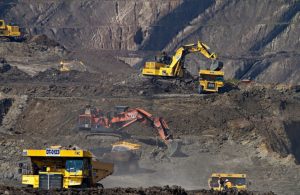
A coal mine
Afrochine Smelting, Chinese company which sparked an international outcry after trying to set up a coal mine inside the Hwange National Park in 2020 – before it was ordered out in 2020, was given a special grant by President Emmerson Mnangagwa last year. The company can now return to mine inside Zimbabwe’s largest game reserve
Hwange communities clash with Chinese coal miners
The year 2021 saw communities in Hwange where Chinese companies are setting up coal mines eventually found their voice and challenged the projects, which they feel pose a serious threat to the environment.
In Dinde, the community strongly opposed plans by a company known as Beifer Investments to set up a coal mine that will displace villagers.
One of the community leaders, Never Tshuma, was arrested for mobilising the community to challenge the setting up of the mine and was released after several weeks in custody.
There are several other Hwange communities that are now challenging the setting of mines in their areas citing pollution and environmental damage. President Emmerson Mnangagwa’s government is defying global trends by seeking to grow the coal mining sector as part of its ambitions to grow the country’s mining industry into a US$12 billion economy by 2023.

Never Tshuma (in brown jacket ) seen leaving the Hwange magistrates court
Chasing Covid-19 herd immunity for Victoria Falls
In March, President Emmerson Mnangagwa got his first shot of China’s Sinovac Covid-19 vaccine in Victoria Falls where he also launched the second of the country’s vaccination drive.
Mnangagwa said Victoria Falls was chosen as the venue to host the launch because the government was starting a programme to ensure that more than 60 percent of the resort city’s population is vaccinated to reach herd immunity and the safe reopening of the country’s tourism industry.
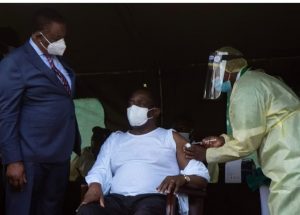
President Emmerson Mnangagwa recieving his first dose of the Sinovac Covid-19 vaccine in Victoria Falls. Looking on is Vice President Constantino Chiwenga
Victoria Falls welcomes new tourist facilities
The US$24.6 million luxurious The Palm River Hotel in Victoria Falls opened its doors to guests in November in a major boost for the resort city’s hospitality landscape.
The Palm River Hotel, which is owned by Old Mutual Zimbabwe, is part of the diversified financial services giant’s diversification to more resilient sectors of the economy such as mining, energy, agriculture and tourism as well as hospitality.
The four star hotel facility overlooks the mighty Zambezi River and is one of the biggest hospitality facilities built in Victoria Falls in the last 20 years.
It is a partnership between Old Mutual and Spencer Creek, a hotel operator that runs the luxurious Ilala Lodge in Victoria falls.
The Palm River Hotel boasts 73 rooms, including a large presidential suite, honeymoon suites and one private villa. It was one of the many facilities that opened their doors to tourists in what was seen as a vote of confidence on Victoria Falls as a tourist destination.

The Palm River Hotel
Human-wildlife conflicts claim lives in Victoria Falls
An elephant killed senior Victoria Falls Anti-Poaching Unit (VFAPU) official Clever Kapundura while he was following up on a suspected poaching incident in a bush adjacent to theChamabondo National Park in October.
Kapundura (51) owas a supervisor at VFAPU. His death brought to the fore the increasing number of wild animals attacking people in the resort town. The following month an elephant trampled to death a bartender, who was coming from work in the city centre.

The late Clever Kapundura



-

 Slider3 years ago
Innscor launches brewery to produce Nyathi beer
-

 National5 years ago
In perched rural Matabeleland North, renewable energy is vital
-

 Tourism and Environment4 years ago
Strive Masiyiwa’s daughter opens luxury Victoria Falls lodge
-

 Special reports4 years ago
Tinashe Mugabe’s DNA show’s popularity soars, causes discomfort for some
-

 Opinion4 years ago
A street art mural in Zimbabwe exposes a divided society
-

 National4 years ago
Victoria Falls’ pilot dies in helicopter crash
-

 National3 years ago
Commission of inquiry findings fail to be tabled as Victoria Falls councillors fight
-

 National3 years ago
Hwange coal miner fires workers over salary dispute