Connect with us

Slider

Zimbabweans count their toes as inflation soars above 130 percent

Published

on

BY FARAI MUTSAKA

Battling rampant inflation, Zimbabweans are counting their toes as they struggle to buy food for their families.

Advertisement

An internet rumour blazed through the country that desperate people were selling their toes for cash.

The false report became so widespread that the country’s deputy minister of Information Kindness Paradza visited street vendors in central Harare earlier this month to debunk it.

One-by-one the traders took off their shoes to show that they had all 10 toes, as Zimbabwe’s state media recorded the digital investigation.

Advertisement

Paradza declared the toes-for-money story a hoax, as did local and foreign fact-checkers.

Police later arrested a street vendor who now faces a fine or six months in jail on charges of criminal nuisance for allegedly starting the story.

It’s starkly true, however, that Zimbabweans are finding it increasingly difficult to make ends meet.

Advertisement

Since the start of Russia’s war in Ukraine, Zimbabwe’s inflation rate has shot up from 66 percent  to more than 130 percent, according to official statistics.

The war in Ukraine has exacerbated inflation rising around the world. Consumer prices in the 19 European Union countries that use the euro currency surged 8.1 percent  in May, a record rate as energy and food costs climb.

In the United States and the United Kingdom, annual inflation hit or was close to 40-year highs of 8.3 percent and nine percent, respectively, in April.

Advertisement

Turkey approached Zimbabwe’s eye-watering prices, with inflation reaching 73.5 percent in May, the highest in 24 years.

In Zimbabwe, the impact of the Ukraine war is heaping problems on the already fragile economy.

The war “coupled with our historical domestic imbalances, has created challenges in terms of economic instability seen through the currency volatility and spilling over into price volatility,” Finance minister Mthuli Ncube told Parliament in May.

Advertisement

Teachers “can no longer afford bread and other basics, this is too much,” tweeted the Progressive Teachers Union of Zimbabwe in early June.

The three largest teachers’ unions are demanding the government pay their salaries in U.S. dollars because their pay in local currency is “eroded overnight.”

“Because of high inflation, the local currency is collapsing,” economic analyst Prosper Chitambara told The Associated Press.

Advertisement

“Individuals and companies no longer trust the local currency and that has put pressure on the demand for United States dollars.

“The Ukraine war is simply exacerbating an already difficult situation.”

Many fear Zimbabwe could return to the hyperinflation of 2008 which reached 500 billion percent, according to the International Monetary Fund. At that time, plastic bags full of 100 trillion Zimbabwe dollar banknotes were not enough to buy basic groceries.

Advertisement

The economic catastrophe forced then-President Robert Mugabe to form a “unity government” with the opposition and adopt a multi-currency system in 2009 in which US dollars and the South African rand were accepted as legal tender.

The US dollar continues to dominate with prices in local currency often benchmarked to the rates for the American currency on the flourishing illegal market, where most individuals and companies get their foreign currency.

Across the country, currency traders line the streets and crowd entrances to shopping centres waving wads of both the local currency and US dollars.

Advertisement

Many Zimbabweans who earn in local currency such as government workers are forced to source dollars on the illegal market, where exchange rates are soaring, to pay for goods and services that are increasingly being charged in US dollars.

Retailers said the rising rates for US dollars on the illegal market are forcing them to frequently increase prices, often every few days, to allow them to restock.

The once-prosperous southern African country’s economy is battered by years of de-industrialization, corruption, low investment, low exports and high debt.

Advertisement

Zimbabwe struggles to generate an adequate inflow of greenbacks needed for its largely dollarized local economy.

Ordinary Zimbabweans are returning to coping mechanisms they relied on during the hyperinflationary era such as skipping meals.

Others now buy food items in smaller quantities, sometimes in such tiny packages they are enough for just a single meal.

Advertisement

Locals call them “tsaona,” meaning “accident” in the local Shona language.

Promising better days ahead, Ncube, the finance minister, said the government “will not hesitate to act and intervene to cushion against price increases and exchange rate volatility.”

Many are sceptical of such vows from the government, saying nothing short of a miracle will pull Zimbabwe out of its economic crisis.

Advertisement

 Even while coping with constantly rising prices, many can’t help making grim jokes about the situation.

“I still have all my toes intact but it wouldn’t hurt selling one,” chuckled Harare resident Asani Sibanda.

“I could still walk without it, but my family would at least get some food.” – AP

Advertisement

Continue Reading
Click to comment

Leave a Reply

Your email address will not be published. Required fields are marked *

In the community

Victoria Falls launches bill-payment incentive program to drive municipal growth

Published

on

BY NOKUTHABA DLAMINI

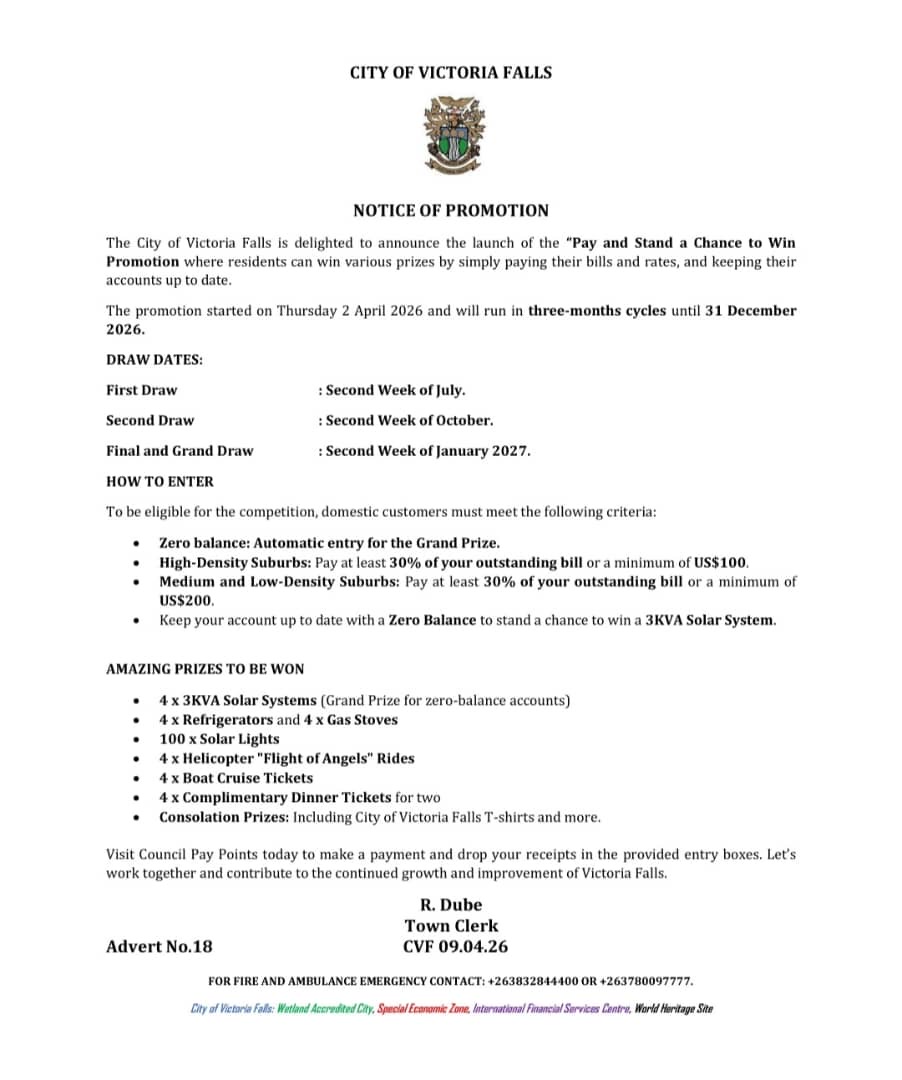
The City of Victoria Falls has launched a promotional campaign offering prizes ranging from solar power systems to helicopter rides to encourage residents to settle their utility bills and rates.

Advertisement

The initiative, titled the “Pay and Stand a Chance to Win Promotion,” began on April 2, 2026, and is scheduled to run in three-month cycles through the end of the year. According to a notice issued by Town Clerk Ronnie Dube, the program aims to have residents work together to contribute to the continued growth and improvement of the city.

To qualify for the draws, domestic customers in high-density suburbs must pay at least 30% of their outstanding balance or a minimum of US$100. Residents in medium and low-density suburbs are required to pay at least 30% of their debt or a minimum of US$200.

The city is offering a tiered prize structure to incentivize different levels of payment. Four 3KVA solar systems are reserved as grand prizes for residents who achieve a zero-balance account. Other prizes in the pool include four refrigerators, four gas stoves, and 100 solar lights.

Advertisement

Leveraging its status as a World Heritage Site, the city is also offering four “Flight of Angels” helicopter rides, four boat cruise tickets, and four complimentary dinner tickets for two. Consolation prizes such as city-branded T-shirts will also be available.

The first draw is scheduled for the second week of July, followed by a second draw in October. The final and grand draw will take place in the second week of January 2027. Residents can enter by making payments at Council Pay Points and dropping their receipts into designated entry boxes.

Advertisement
Continue Reading

National

30 killed in Easter road crashes as pedestrians bear the brunt

Published

on

BY WANDILE TSHUMA 

The Zimbabwe Republic Police has reported a worrying rise in road fatalities during the 2026 Easter holiday, despite a decline in the total number of accidents.

Advertisement

According to the police, 30 people were killed in road traffic accidents during the holiday period, up from 24 deaths recorded in 2025. However, the total number of accidents dropped from 384 in 2025 to 337 in 2026, while injuries also decreased significantly from 178 to 104. 

Police said 22 of the recorded accidents were fatal, compared to 21 during the same period last year. 

Pedestrians most affected

Advertisement

Pedestrians accounted for the majority of fatalities, making up 63% of the deaths (19 people). Passengers were the second most affected group with seven deaths (23%), followed by drivers with three (10%), while one rider (3%) was killed. 

Speeding, overtaking blamed

Authorities identified speeding as the leading cause of accidents during the period, with many drivers losing control of their vehicles. Unsafe overtaking was also cited as a major contributor to head-on collisions. 

Advertisement

Deadly incidents recorded

One of the most tragic incidents occurred on 2 April 2026, when six family members died after a head-on collision between a Toyota Corolla and a truck along the Harare–Masvingo Road. 

In another traffic accident , seven people were killed and four injured on 3 April 2026 at the 51km peg along the Bulawayo–Beitbridge Road. A truck rammed into three vehicles — a Nissan March, Toyota Probox and Toyota Hiace — before striking pedestrians who had gathered at the scene. 

Advertisement

Police warning

The police have urged motorists to exercise caution, obey traffic laws and avoid speeding, especially during peak travel periods. Drivers involved in accidents are also being reminded to stop, render assistance and report incidents.


Advertisement

Continue Reading

National

Econet InfraCo targets ultra-luxury market with Vic Falls resort

Published

on

BY STAFF REPORTER 

Econet InfraCo has unveiled plans for a multimillion-dollar luxury resort in Victoria Falls, marking a strategic push by the billion-dollar infrastructure platform into high-end tourism.

Advertisement

The development, branded Vic Falls Lifestyle, will feature 40 luxury residential villas supported by premium amenities, including restaurants, wellness centres and sports facilities.

Chief executive Fayaz King described the project as a landmark for Zimbabwe’s luxury tourism segment.
“These will be among the most exclusive residential properties ever developed in Zimbabwe, designed to meet top-tier international hospitality standards comparable to presidential suites in leading global hotels,” he said.

The project aims to reposition Victoria Falls as a destination for affluent global travellers seeking privacy, exclusivity and fully integrated services.
Recently listed on the Victoria Falls Stock Exchange with a valuation of about US$1 billion, Econet InfraCo said the resort will include a 24-hour, 10-bed private hospital offering emergency and dental services—an amenity tailored to high-net-worth clientele.
Security and privacy will be central to the offering, with the gated development providing round-the-clock protection for residents and guests.

Advertisement

Under the investment model, buyers will own individual villas but will be required to place them in a rental pool for up to 11 months a year, balancing personal use with income generation.

“Victoria Falls needs developments of this calibre to attract visitors who not only spend, but invest,” King said.

Econet founder and group chairman Strive Masiyiwa played an advisory role in shaping the concept and is expected to be among the property owners.
The company said the project has already drawn interest from local and diaspora investors, as well as international buyers.

Advertisement

Land has been secured, planning is at an advanced stage, and construction is scheduled to begin before year-end.

The Victoria Falls resort is Econet InfraCo’s second major project. Its flagship, Econet Tech City, is a planned industrial and technology hub near Robert Gabriel Mugabe International Airport in Harare, expected to host around 300 businesses across more than 800 hectares.

Advertisement
Continue Reading

Trending

Copyright © 2022 VicFallsLive. All rights reserved, powered by Advantage