Connect with us

National

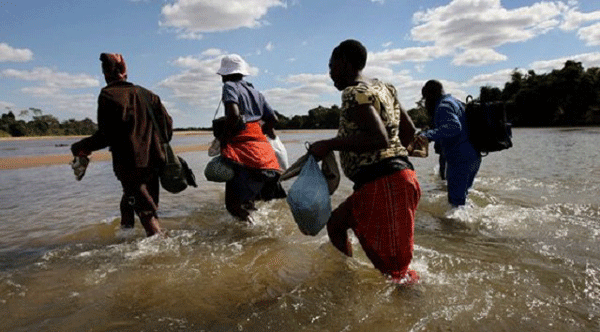
Zimbabwean border jumpers ‘abused in Beitbridge’

Published

on

WASHINGTON– The opposition Movement for Democratic Change Alliance led by Nelson Chamisa has condemned Zimbabwean soldiers for allegedly beating and torturing local people being deported by the South African government.

In a statement, the MDC Alliance South Africa chapter said, “We would like to condemn in the strongest terms the harassment and abuse of deported Zimbabweans by Zimbabwean soldiers at the Beitbridge border post.

Advertisement

“These are desperate Zimbabweans attempting to cross into South Africa because there are no jobs nor cheap healthcare in Zimbabwe.

“Scenes of huddled poor Zimbabweans surrounded by horse-riding, gun-totting soldiers are disconcerting.

“This in the midst of the fourth wave is uncalled for and illogical.

Advertisement

“Equally puzzling are beatings being meted out on the hapless deportees by the soldiers and police officers.

“The behaviour of the soldiers is callous and undeserved, and should therefore be stopped promptly.”

Social media is awash with photographs of Zimbabweans detained by soldiers at the Beitbridge border post amid a crackdown launched by the South African government to flush out illegal immigrants.

Advertisement

“We expect the clueless Harare regime to adopt a people-centred approach to deal with the migration of Zimbabweans to South Africa,” the MDC Alliance added.

“The Zanu-PF government is the author of the economic and political problems ordinary Zimbabweans are running away from.

“How ironic is it that army officers from the underperforming Zimbabwean government are brutalising Zimbabweans for looking for greener pastures?

Advertisement

“The humanitarian crisis being created at the Beitbridge border post requires both the Zimbabwean and South African governments to work together to find long-lasting solutions to this annual migration.”

The MDC Alliance appealed to the South African government to lead the Southern African Development Community in ensuring there are political, media and electoral reforms in Zimbabwe, which can create a conducive environment for the holding of free and fair elections next year.

“As long as Zimbabwe has political problems, the economy will continue to shrink resulting in the obtaining scenario at the busy border post.

Advertisement


“We reiterate that only a change of government in Zimbabwe will styme the exodus of the unemployed and the infirm from our country,” the party said.


Advertisement

“The MDC-A is ready to govern and improve the economy so that good healthcare, jobs and business opportunities will be available to people of all political persuasions and nationalities.


“We are an inclusive party.” – VOA

Advertisement

Continue Reading
Click to comment

Leave a Reply

Your email address will not be published. Required fields are marked *

National

Unregulated mining pushes Zimbabwe toward environmental and public health crisis

Published

on

BY STAFF REPORTER

Zimbabwe is facing a deepening environmental and public health emergency driven by unchecked mining activities, with environmental experts warning that the situation has escalated into a national security concern.

Advertisement

The alarm was raised during discussions aired on recently at CITE, where environmental leaders unpacked the scale of ecological damage unfolding across the country.

Centre for Natural Resource Governance (CNRG) Executive Director Farai Maguwu said Zimbabwe’s mining boom has reached crisis levels, fuelled largely by economic decline and the collapse of formal employment.

“Mining has become the default survival strategy for many Zimbabweans,” Maguwu said, noting that widespread job losses and industrial shutdowns have pushed communities toward extractive activities as a quick source of income.

Advertisement

He warned that weak governance has allowed mining to spread into protected and ecologically sensitive areas, despite existing policies that prohibit such activities.

“We are seeing mountains disappearing and rivers being destroyed. Even with a ban on riverbed mining, enforcement has collapsed,” Maguwu said.

According to Maguwu, mining has encroached into UNESCO heritage sites and protected zones such as Mavuradona Wilderness, while areas like Shurugwi and Poterekwa Mountain have suffered extensive damage.

Advertisement

More concerning, he alleged that some law enforcement agents and senior officials are complicit in environmental destruction.

“In places like Penhalonga, elements within the police, military, senior government structures and intelligence services are allegedly part of mining syndicates,” he said, warning that the crisis now threatens national stability.

Maguwu also highlighted the dangers of mining beneath roads and residential areas, which he said could result in catastrophic collapses and flash floods.

Advertisement

“They are creating underground dams in mountains. When these give way, people will be swept away,” he said.

He criticised what he described as a lack of urgency from authorities in responding to the scale of destruction.

“If government is concerned about the future of this country, the current level of environmental damage should be setting off alarm bells,” Maguwu said.

Advertisement

He further explained that the shift from underground mining to open-cast methods has accelerated deforestation, land degradation and loss of agricultural land, undermining food security.

The uncontrolled use of toxic substances such as mercury and cyanide, particularly during the rainy season, has also heightened contamination risks.

“These chemicals are being dumped indiscriminately, with no punitive measures in place,” he said, warning that rainfall washes toxins into rivers, dams and streams.

Advertisement

Maguwu expressed particular concern for rural communities dependent on untreated water from shallow wells, especially in Marange and Matabeleland North.

“People are drinking contaminated water. The long-term health consequences are devastating and still unfolding,” he said, describing the crisis as an “environmental Armageddon.”

Similar concerns were echoed by Nkosikhona Sibanda, Executive Director of the Centre for Environmental and Corporate Accountability Research (CECAR), who said the crisis is nationwide.

Advertisement

In Matabeleland North, Sibanda said mining activity—particularly by Chinese-owned companies—has intensified in areas such as Hwange, Kamativi in Binga, and surrounding districts.

“When communities hear about foreign investment, they expect development. Instead, they are experiencing severe environmental degradation,” Sibanda said.

Studies conducted between 2024 and 2025, he added, revealed dangerous levels of air pollution in Hwange.

Advertisement

“The results were shocking. Air quality is far beyond safe limits, and people are breathing toxic substances daily,” Sibanda said.

Health facilities in affected areas have reportedly recorded a rise in respiratory illnesses and chronic diseases, underscoring the growing human cost of environmental neglect.

“This is no longer just an environmental issue—it is a public health emergency,” Sibanda said.

Advertisement

This report is based on information originally published by the Centre for Innovation and Technology (CITE).

Advertisement
Continue Reading

National

World AIDS Day: UN Chief says ending AIDS by 2030 “is within grasp”

Published

on

BY SONIA HLOPHE

United Nations Secretary-General António Guterres has marked World AIDS Day with a message urging world leaders to scale up investment, confront stigma and ensure that lifesaving HIV services reach everyone who needs them.

Advertisement

In his statement, Guterres said this year’s commemoration serves as a reminder that the world “has the power to transform lives and futures, and end the AIDS epidemic once and for all.”

He highlighted the major gains achieved over the past decade.

“The progress we have made is undeniable,” he said, noting that “since 2010, new infections have fallen by 40 per cent” while “AIDS-related deaths have declined by more than half.” Access to treatment, he added, “is better than ever before.”

Advertisement

But despite this global progress, the Secretary-General warned that the crisis is far from over.

“For many people around the world, the crisis continues,” he said. “Millions still lack access to HIV prevention and treatment services because of who they are, where they live or the stigma they endure.”

Guterres also raised concern over shrinking resources:

Advertisement

“Reduced resources and services are putting lives at risk and threatening hard-won gains.”

He said ending AIDS requires fully supporting communities, scaling up prevention and ensuring treatment for everyone.

“Ending AIDS means empowering communities, investing in prevention and expanding access to treatment for all people.”

Advertisement

He also called for innovation to be matched by real-world delivery:

“It means uniting innovation with action, and ensuring new tools like injectables reach more people in need.”

Above all, he stressed the need for a human-rights centred response so no one is excluded.

Advertisement

“At every step, it means grounding our work in human rights to ensure no one is left behind.”

With the 2030 global deadline approaching, the UN chief said success is still possible if momentum is sustained.

“Ending AIDS as a public health threat by 2030 is within grasp. Let’s get the job done.”

Advertisement


Advertisement
Continue Reading

National

Zimbabwe fast-tracks approval of long-acting HIV prevention drug Lenacapavir

Published

on

BY WANDILE TSHUMA

Zimbabwe has taken a major step in the fight against HIV following the rapid approval of Lenacapavir, a groundbreaking long-acting injectable for HIV pre-exposure prophylaxis (PrEP). The Medicines Control Authority of Zimbabwe (MCAZ) authorised the drug in just 23 days, marking one of the fastest regulatory approvals in the country’s history.

Advertisement

The application, submitted by pharmaceutical company Gilead Sciences in October, underwent an expedited review because of its public health importance. MCAZ says the fast-tracked process did not compromise scientific scrutiny, with the product subjected to a rigorous assessment of its safety, efficacy and quality.

Lenacapavir is designed for adults and adolescents weighing at least 35kg who are HIV-negative but at substantial risk of infection. Unlike traditional daily oral PrEP, the medicine is administered as a six-monthly injection, following an initiation phase that includes one injection and oral tablets on Days 1 and 2. Health authorities say this long-acting formulation could dramatically improve adherence and expand prevention options, particularly for communities where daily pill-taking is difficult.

MCAZ Director-General  Richard T. Rukwata described the approval as a landmark moment in Zimbabwe’s HIV response.

Advertisement

“The rapid approval of Lenacapavir reflects MCAZ’s dedication to accelerating access to trusted, high-quality health products. This milestone brings new hope for HIV prevention and reinforces our commitment to safeguarding public health,” he said.

To fast-track the process, the Authority applied a regulatory reliance approach, drawing on scientific assessments from the World Health Organization’s Prequalification Programme (WHO PQ). This allowed evaluators to build on internationally recognised review processes while ensuring Zimbabwe’s own standards were met.

The introduction of Lenacapavir comes as Zimbabwe continues efforts to reduce new HIV infections, particularly among young people and key populations who face barriers to consistent PrEP use. Public health experts say the drug’s twice-yearly dosing could be a game changer in improving uptake and protection.

Advertisement

MCAZ says it remains committed to ensuring Zimbabweans have access to safe, effective and good-quality medical products, in line with its mandate under the Medicines and Allied Substances Control Act.

Advertisement
Continue Reading

Trending

Copyright © 2022 VicFallsLive. All rights reserved, powered by Advantage