Connect with us

National

Zambezi River Authority warns of critical water levels at Kariba dam

Published

on

BY WANDILE TSHUMA

The Zambezi River Authority has sounded the alarm on the dire water levels at Kariba Dam, the main source of hydroelectricity for Zimbabwe and Zambia.

Advertisement

The dam’s usable live storage has plummeted to a mere 2.40%, leaving the two countries with a precarious electricity supply.
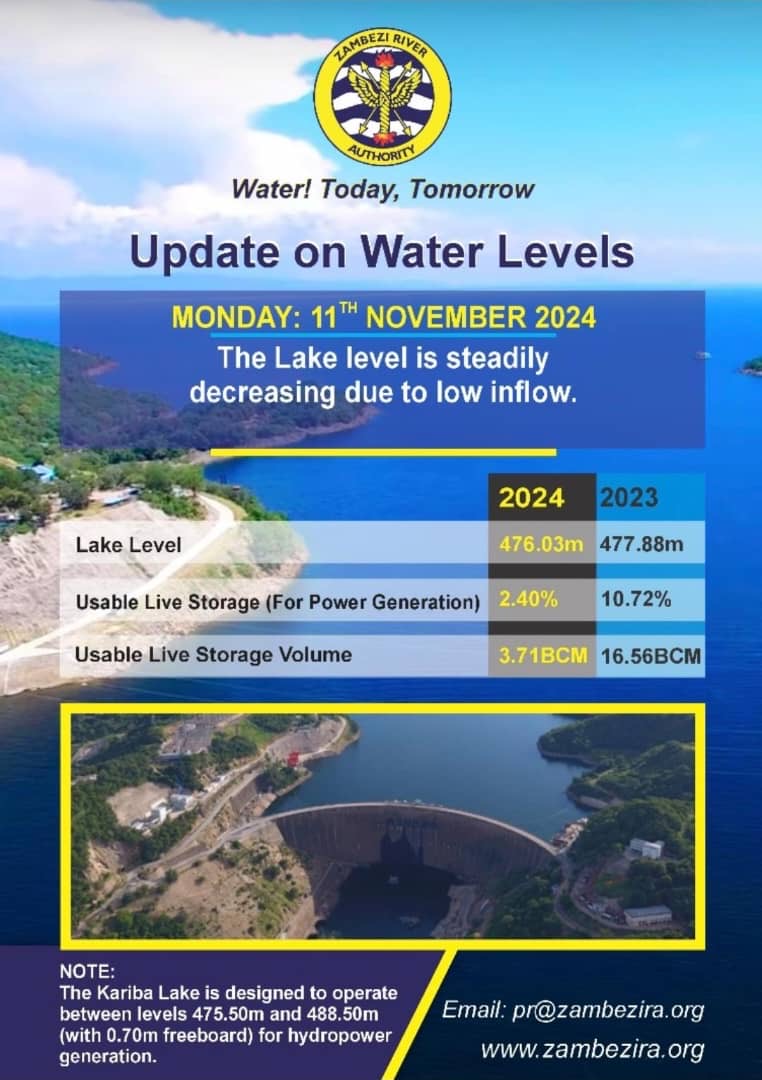
The drastic decline in water levels is attributed to the prolonged drought situation, exacerbated by climate change and induced droughts.

This has resulted in reduced water inflows, severely impacting the dam’s ability to generate electricity.

In Zimbabwe, communities are already feeling the pinch, with widespread electricity shortages reported.

Advertisement

Retailers have complained about the inability to conduct business due to frequent power outages.

Stay tuned for further updates as this story continues to unfold.

Advertisement
Continue Reading
Click to comment

Leave a Reply

Your email address will not be published. Required fields are marked *

National

Zambia, Zimbabwe to ban heavy trucks from Victoria Falls Bridge

Published

on

BY DUMANI MOYO

Zambian President Hakainde Hichilema has announced that Zambia and Zimbabwe will restrict heavy trucks and trains from using the century-old Victoria Falls Bridge.

Advertisement

Speaking at an engineering conference in Livingstone, he said the two countries will instead build a new bridge and railway crossing to handle modern freight demands.

Hichilema made it clear that the 121-year-old structure can no longer safely or efficiently carry today’s heavy-duty traffic.

Engineers designed the bridge in the early 1900s for much lighter loads, not for fully laden 60-tonne mining trucks or long freight trains that now dominate regional trade routes.

Advertisement

Engineers completed the Victoria Falls Bridge in 1905 as a narrow arch crossing linking road, rail and pedestrian traffic.

While it remains an iconic piece of infrastructure, its design limits its ability to support modern logistics.

Authorities have already imposed restrictions over the years.

Advertisement

Trains often move at very low speeds, while trucks have faced weight limits that forced heavier vehicles to reroute through other crossings.

Although rehabilitation work in 2006 extended the bridge’s lifespan, it did not solve the fundamental structural limitations.

Experts now agree that upgrading the bridge to meet current freight standards would cost nearly as much as building a new one.

Advertisement

WHY A NEW CROSSING MAKES ECONOMIC SENSE

Officials from both countries now favour constructing a new dual-purpose rail and road bridge instead of attempting further upgrades.

A purpose-built crossing would accommodate higher traffic volumes and modern freight loads without compromising safety.

A new structure would also eliminate a major bottleneck along the North-South Corridor, which links the copper belts of Zambia and the Democratic Republic of Congo to southern markets such as South Africa.

Advertisement

By separating heavy commercial traffic from tourism and local travel, the new bridge would allow the Victoria Falls Bridge to serve lighter vehicles, pedestrians and tourists, preserving its heritage value.

REGIONAL TRADE AND RAIL INTEGRATION BOOST

The proposed crossing would complement major regional projects, including the Mosetse-Kazungula-Livingstone Railway.

A dual-track rail bridge would strengthen links between Zambia and Zimbabwe while supporting long-term plans to expand rail connectivity across Southern Africa.

Advertisement

It would also mirror the successful model of the Kazungula Bridge, which has significantly increased traffic flow since opening in 2021.

FINANCING AND NEXT STEPS

Despite strong political backing, key questions remain around funding, construction timelines and project ownership.

Zimbabwe’s debt constraints could complicate financing, although improved economic reforms may unlock support from international lenders.

Advertisement

If both governments secure funding and move quickly, the new bridge could become one of the most important infrastructure developments in the Southern African Development Community in recent years.

This could transform trade flows and ease congestion along a critical regional corridor.

SOURCE: THE SOUTH AFRICAN

Advertisement

Continue Reading

National

Health ministry rolls out polio vaccination campaign

Published

on

BY OWN CORRESPONDENT

Ministry of Health and Child Care has launched a targeted polio vaccination campaign in selected districts, with health workers going door-to-door and setting up outreach points to reach young children.

Advertisement

The campaign aims to vaccinate all children under the age of five against polio, a highly infectious disease that can cause paralysis. Authorities say the initiative forms part of a wider regional effort to interrupt transmission, being conducted alongside neighbouring countries including Botswana, Malawi, Mozambique and Zambia.

In a message posted on X on Monday and circulated in official memos, the ministry said it was “embarking on a targeted polio vaccination campaign to interrupt the transmission of polioviruses”. It urged families in affected areas to ensure that all eligible children are vaccinated, regardless of their previous vaccination status.

The programme will be carried out in two rounds, from 20 to 23 April and from 2 to 5 June, covering both urban and rural communities.

Advertisement

In Bulawayo Metropolitan Province, vaccination teams are operating in Emakhandeni, the Northern Suburbs and Nkulumane. In Harare Metropolitan Province, the campaign covers Harare, Chitungwiza, Epworth and Ruwa.

In Manicaland Province, teams are working in Mutare, Mutasa, Chimanimani and Chipinge. In Mashonaland Central, the campaign targets Mbire, Mt Darwin, Centenary and Rushinga, while in Mashonaland East it focuses on Mudzi. In Mashonaland West, Kariba and Hurungwe are included.

Further south, the drive extends to Chiredzi in Masvingo Province, as well as Binga, Hwange and Tsholotsho in Matabeleland North. In Matabeleland South, teams are operating in Bulilima, Mangwe, Matobo and Gwanda.

Advertisement

Health workers are using a combination of fixed vaccination sites, mobile units and door-to-door visits in neighbourhoods, markets, shops and clinics to reach eligible children, including those in remote and hard-to-access areas.

The ministry has called on parents and guardians to cooperate with vaccination teams, saying the campaign is critical to protecting children and preventing the spread of the disease.

SOURCE: CITE

Advertisement

Continue Reading

National

Strive Masiyiwa speaks on how Econet Tech City will work

Published

on

BY OWN CORRESPONDENT

Econet founder and group chairman Strive Masiyiwa, whose company recently listed Econet InfraCo – an infrastructure platform company –  says he was inspired to build an industrial hub in Harare, called Econet Tech City, after observing similar hubs spring up in other African and Asian cities.

Advertisement

In particular Masiyiwa made reference to the 12 000-hectare Eko Atlantic hub in Lagos, Nigeria, built on reclaimed land, where his Data Centre group has established a large facility.

“Modern international investors don’t like hassles when they plan to build a factory or high tech facility, like a Data Centre,” he said.

“They prefer locations where everything they need – such as power, water, fibre and satellite connectivity, industrial waste management, security, street lighting and staff transport – is readily available.

Advertisement

They don’t want to be burdened with complex local planning approvals or licensing processes.

These industrial hubs operate as a one-stop shop, managed by local experts who handle everything for them.

“When we build a data centre in an African city, it is a highly complex project and we seek these hubs, some even offering legal services.” He explained.

Advertisement

Econet InfraCo – which is listed on the Victoria Falls Stock Exchange, with an estimated valuation of US$1 billion dollars – owns an 800-hectare property near the Robert Mugabe International Airport in Harare.

It is currently in the process of turning it into a modern industrial hub – pending government approval – and is expected to attract 300 companies, creating over 20 000 jobs.

Tech City will not only be built by Econet InfraCo; the company will also continue to manage it on behalf the tenants. It will be surrounded by a security wall, with 24-hour guards protecting the perimeters, complete with CCTV and drone surveillance.

Advertisement

Masiyiwa said Econet InfraCo plans to address infrastructure challenges for investors in collaboration with the government.

“The goal is to build a self-sufficient ‘city within a city’, surpassing the pre-independence industrial areas, complete with a shopping mall and clinic, but excluding housing and offices. It is intended to create a spark for industrialization,” Masiyiwa said.

He said the site chosen by Econet InfraCo includes a large stream, crucial for water supply, and will utilize a 100MW solar plant.

Advertisement

Architects and engineers are already developing plans, with solar panels for the first phase arriving from China soon.

Econet, which already has a 5MW data centre in Willowvale, Harare, is planning to build a 10MW facility in Tech City. The industrial hub is the first major project that Econet InfraCo is undertaking.

Regarding project timelines, Masiyiwa said: “From Econet’s perspective, we can complete the site within two years, but government incentives for businesses are crucial.

Advertisement

“Zimbabwe is competing with cities like Lagos, Cape Town, Nairobi and Kigali. I have laid out the vision and discussed it with Zimbabwean leaders.

“If they and the people support it, this could be a great partnership. I envision similar projects across Africa, as I am a Pan-Africanist, but I always start in my country.”

Masiyiwa hopes Econet Tech City will be operational within five years, emphasising the pressing need for jobs for young people, which he said is “too urgent to ignore”.

Advertisement

He said since unveiling the plans, Econet has received inquiries from both local and international companies and discussions with the government were already underway.

Once finalised, he said Econet InfraCo will begin marketing the project to potential investors and start rolling out the facility in phases.

He added that Econet will not seek exclusive terms from the government, in the hope that the offer will extend to others with similar projects in Harare or other cities.

Advertisement

SOURCE: The Standard 

Advertisement
Continue Reading

Trending

Copyright © 2022 VicFallsLive. All rights reserved, powered by Advantage